

The Recovery Dependency Nobody Admits: Ransom Payment Bans Are Making It Visible
A ransom payment ban doesn’t eliminate the ransomware business model by itself — it eliminates an option most recovery plans quietly assumed would still be there once everything else had already failed. The UK government confirmed in July 2025 that it will introduce a targeted ban on ransom payments by public sector bodies and critical national infrastructure operators, delivered through its own dedicated secondary legislation — a separate policy track from the Cyber Security and Resilience Bill currently before Parliament, which handles incident reporting and regulator powers. Private organizations won’t be banned outright but will be required to notify the government before paying anything at all. North Carolina and Florida have banned public-sector payment outright since 2021 and 2022, respectively. Australia took a different route — mandatory reporting rather than a ban — but the intent is the same: make the decision to pay visible, and in a growing number of cases, illegal. None of this is really a ransomware story. It’s a dependency story, and most recovery architectures have never been audited for the specific dependency these laws are now removing.
The Recovery Capability That Was Never a Capability
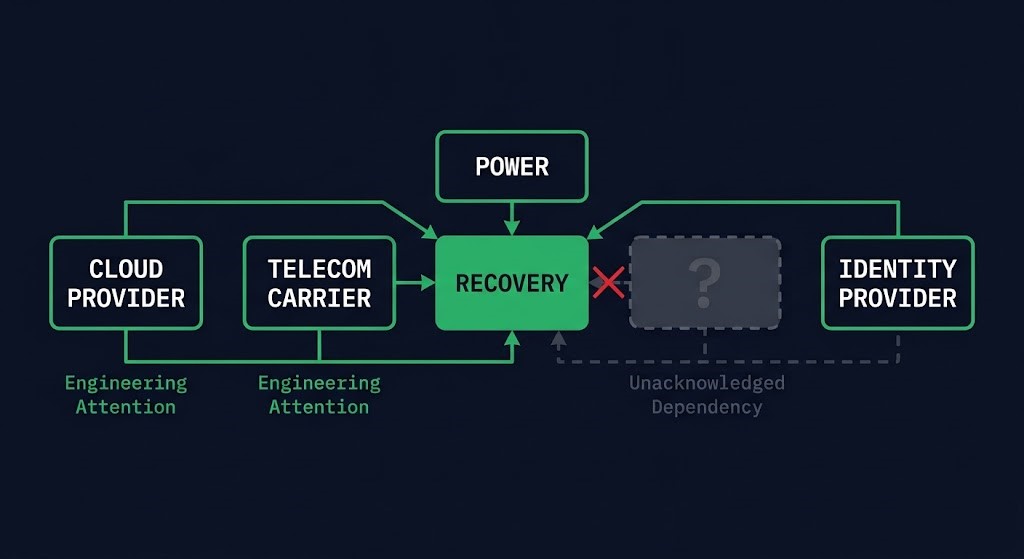
Ask most infrastructure teams what their ransomware recovery plan depends on and they’ll list backups, isolation, immutability, restore sequencing, maybe an incident-response retainer. Almost nobody lists the line that actually closes most real tabletop exercises, spoken instead of written down: if none of that works, we pay.
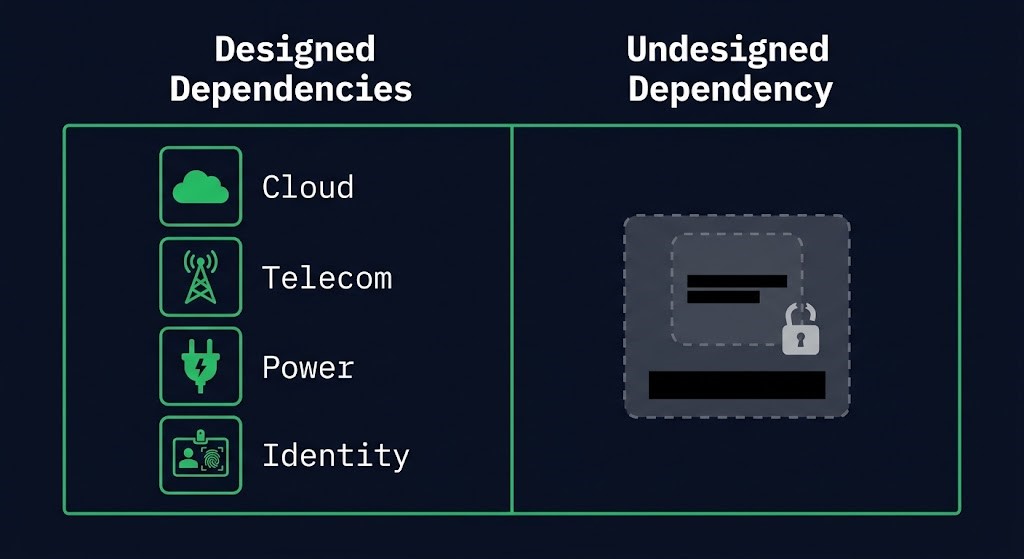
Architecturally, that line does something specific. It converts an external actor — a criminal counterparty with no contractual obligation, no SLA, no guaranteed capability, and no accountability to anyone — into a recovery mechanism. Not a last resort in the colloquial sense. A dependency, in the same structural sense a recovery plan depends on a cloud provider staying available, a telecom carrier routing traffic, or an identity provider issuing tokens. The difference is that architects are trained to name and design around the first three. The fourth one rarely gets named at all, because naming it means admitting the plan was designed to fail over to a service the organization doesn’t control, can’t test, and may not be legally permitted to describe honestly after the fact.
This is close to home for Rack2Cloud’s own recovery-maturity territory. Framework #146, the Recovery Design Boundary, draws the line between recovery characteristics that were intentionally designed and recovery characteristics that only get discovered at restore time — the D1 stage of the Data Protection & Resiliency Learning Path builds that boundary out in full. A recovery mechanism that depends on conditions entirely outside the organization’s control — the continued willingness of a criminal actor to honor a transaction — sits on the wrong side of that boundary by definition, whether or not a government ever legislates against it — precisely the kind of gap data protection architecture exists to close before an incident finds it. That’s not a new failure mode. It’s the same shape as a recovery boundary that stops at asset ownership while the service it protects depends on something the organization doesn’t control — different dependency, identical blind spot.
Why Governments Are Doing This
Briefly, because it matters for the architecture argument, not because it’s the interesting part: the rationale isn’t that regulators believe organizations can recover instantly without paying. It’s that every payment funds the next attack, and every payment that stays private removes the pressure to fix the underlying architecture. A payment ban — paired with mandatory reporting where an outright ban isn’t politically viable, as in Australia — targets the business model, not any individual victim’s recovery odds. The UK’s own framing is explicit about this: the goal is disrupting the economics that make ransomware profitable, not a judgment that any specific organization deserved to lose the option.
The architectural consequence doesn’t depend on whether the policy is correct. Once payment is prohibited, or gated behind a notification and approval process too slow for an active incident, organizations have to operate as though the dependency simply doesn’t exist. Whether that was the right call for policymakers to make is a separate argument entirely. For the infrastructure architect, the only question that matters: does the recovery plan still work with that branch removed?
The Dependency Nobody Tabletops
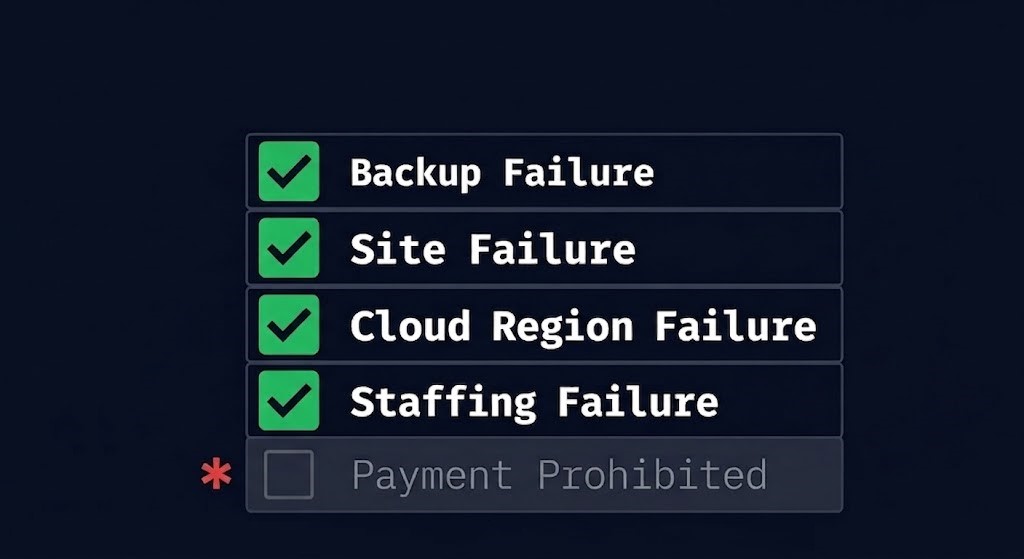
Most disaster recovery programs test failure domains methodically — backup failure, site failure, cloud-region failure, staffing failure. Adversarial restore testing exists precisely because passing those cooperative tests and surviving an actual incident turned out to be different questions: it asks whether a restore sequence holds up under active interference, not just a controlled exercise.
Almost nobody runs the equivalent test for the payment branch. Nobody tabletops “payment is legally prohibited.” Nobody tests “payment is technically legal but requires a notification window the incident won’t wait for.” Nobody models what happens when the approval authority for an emergency payment decision is a regulator who has never seen the organization’s environment and has no obligation to move at incident speed.
That’s not an oversight. It’s the predictable result of treating payment as an unstated emergency option rather than a designed dependency. Nobody writes a test plan for a fallback the organization has never formally acknowledged exists.
Signs Payment Has Become a Recovery Dependency
You almost never find this dependency documented. You find it indirectly, through recovery assumptions that stop making sense once payment is removed from the model:
SIGNS OF THE DEPENDENCY
- Recovery time objectives that are only achievable if decryption succeeds — not if restoration does
- Restore testing scoped to a subset of systems small enough to keep the exercise comfortable
- Immutable backup coverage with quiet exceptions for the systems that would be hardest to rebuild
- No validated identity-rebuild process independent of the identity provider that same incident just took down
- Recovery sequencing that exists as an assumption in people’s heads, not as a tested, written document
- Business continuity RTOs promised to the business that exceed what the recovery architecture has ever actually demonstrated, with the gap quietly absorbed by “we’d figure it out”
None of these reads as a ransomware problem on its own. Each is a connected air gap problem, a Recovery Design Boundary problem, or a Recoverability Gap problem wearing a ransomware costume. Framework #148, the Recoverability Gap, models exactly this: whether the authority chain required to execute recovery — identity, credentials, control-plane orchestration, backup access, governance approval, storage isolation — survives the same event that triggered recovery, across five adversarial threat scenarios, not just backup integrity or decryption success. Its own anchor post makes the point that matters most here: “the backups are intact” has never been the same claim as “the organization recovered.”
This Isn’t Only a Public-Sector Problem
It’s tempting for a private-enterprise architect to read the UK and US state examples and conclude this is a government problem. That reading has a short shelf life. The direction of travel doesn’t require a universal private-sector ban to matter: insurers are increasingly scrutinizing payment-dependent recovery assumptions during underwriting, not just the presence of ransomware controls. Sanctions exposure makes paying an unidentified counterparty a compliance question, not just an operational one. Board-level scrutiny of ransomware response has moved from “did we recover” to “what did recovery actually depend on.” Disclosure obligations are expanding faster than payment restrictions are, and contractual language — cyber insurance policies, enterprise customer agreements — is starting to ask the dependency question directly.
None of that requires predicting where the next ban lands. It only requires recognizing that a recovery strategy built around a dependency regulators, insurers, and boards are all independently trying to eliminate is becoming harder to justify, harder to insure, harder to conceal, and harder to execute — roughly in that order, for most organizations reading this.
Architect’s Verdict
For years, organizations treated ransom payment as an emergency recovery option — expensive, uncomfortable, but available if the rest of the plan failed. Increasingly, governments are treating it as an unacceptable one, and using the law to make that decision on the organization’s behalf.
The lesson isn’t that regulation changed. A recovery architecture built around the continued availability of a criminal counterparty’s cooperation was never as self-sufficient as its RTO slide made it look — a ransom payment ban doesn’t create that dependency, it forces the organization to find out in public whether it ever designed around not having one.
If recovery still depends on someone else’s willingness to sell you a way out, recovery was never fully yours to begin with.
Additional Resources
View 1 more resource
Editorial Integrity & Security Protocol
This technical deep-dive adheres to the Rack2Cloud Deterministic Integrity Standard. All benchmarks and security audits are derived from zero-trust validation protocols within our isolated lab environments. No vendor influence.

R.M.
Senior Solutions Architect with 25+ years of experience in HCI, cloud strategy, and data resilience. As the lead behind Rack2Cloud, I focus on lab-verified guidance for complex enterprise transitions. View Credentials →
Get the Playbooks Vendors Won’t Publish
Choose the architecture problems you care about. Get field-tested playbooks and frameworks delivered to your inbox.
- > AI Infrastructure & Inference Economics
- > Cloud Strategy & Hidden Cost Models
- > Virtualization & Deterministic Migration
- > Kubernetes, IaC & Modern Infrastructure
- > Data Protection & Recovery Engineering
Zero spam. Includes The Dispatch weekly drop.
Need Architectural Guidance?
Independent review before major infrastructure decisions.
- > Validate assumptions
- > Identify hidden dependencies
- > Quantify migration risk
- > Challenge vendor narratives
Triage · Advisory · Fractional · Direct Hire