


CONTROL PLANE ARCHITECTURE
What governs the architecture? — The Strategic Stage of Cloud Strategy

MATURITY POSITION — CLOUD ARCHITECTURE STAGE 04 OF 07
- Current Stage: Strategic — Maturity Stage 04 of 07
- Primary Architectural Concern: Identifying which control plane actually governs architectural decisions — as distinct from which team formally owns the system — and locating the point at which responsibility for a system diverges from authority over its operation
- Primary Failure Mode: Authority-Fragmented Architecture — the condition where multiple systems appear to govern overlapping decisions, but no single authority model exists to explain how decisions are made, enforced, or overridden
- Stage Outcome: Ability to identify the Control Plane Ownership Boundary for a given decision domain; ability to distinguish ownership from authority; ability to map which control plane actually authorizes, denies, enforces, or overrides architectural decisions
- Next Stage: CS5 — Operational Architecture — How is authority operationalized?
Control plane architecture is the discipline of identifying which systems actually govern the behavior of a cloud environment — as distinct from which systems are formally responsible for it. The two are not the same, and the gap between them is where architectural authority quietly goes missing.
The first three stages of this path read the architecture from the outside in. Dependency Architecture mapped what exists. Movement Architecture mapped what those dependencies prevent. Economic Architecture read what those movement constraints cost — and identified the point at which cost stops being a number on an invoice and starts being a deciding factor. Control plane architecture changes the angle of inquiry. Instead of asking what constrains the system, it asks what governs it: when a decision has to be made — to allow, deny, enforce, or override — which system actually makes that call, and does anyone know that in advance?
WHY THIS STAGE EXISTS — AUTHORITY-FRAGMENTED ARCHITECTURE
Modern cloud environments rarely fail because authority is absent. They fail because authority is distributed across multiple control planes with no architectural model describing which one governs the system.
Stage Anchor Question
What governs the architecture?
Architectures are not governed by the systems teams own. They are governed by the systems capable of authorizing, denying, enforcing, or overriding architectural decisions.
Ownership and authority are routinely conflated, and the conflation is where this stage begins. An AWS account team owns the account — but does it govern what can run inside it? An identity team owns Okta — but does it govern what Okta is permitted to authenticate into? A security team owns OPA — but does it govern whether OPA’s policies are actually enforced at the point of decision? A platform team owns Backstage — but does it govern what gets deployed through it, or only what gets cataloged? In each case, ownership is clear and uncontested. Authority is the open question.
Earlier stages established dependency, movement, and economic constraints. CS4 begins the authority sequence by identifying where architectural authority actually resides — not who is accountable for a system on an org chart, but which system’s decisions actually propagate. Cross-pillar reference: Framework #132 — Coordination Density — explains why authority becomes increasingly difficult to identify as coordination layers multiply. As orchestration systems, policy engines, approval chains, and automation frameworks accumulate between a decision and its execution, architectural authority becomes distributed faster than it becomes visible. CS4 does not depend on #132 — it picks up the condition #132 describes and asks the question that follows from it: once authority is this distributed, where does it actually sit?
How Control Plane Architecture Anchors the Full Path
| Stage | Name | Question |
|---|---|---|
| 01 | Dependency Architecture | What are we dependent on? |
| 02 | Movement Architecture | What controls our movement? |
| 03 | Economic Architecture | What determines our economic structure? |
| 04 | Control Plane Architecture | What governs the architecture? |
| 05 | Operational Architecture | How is authority operationalized? |
| 06 | Strategic Governance | Who governs authority? |
| 07 | Strategic Resilience | How does authority survive failure? |
The first three stages establish what exists, how it moves, and what it costs. CS4 is the pivot: it identifies where architectural authority resides — the precondition for everything the second half of the path addresses. CS5 asks how that authority is operationalized. CS6 asks who governs it. CS7 asks how it survives failure. Without CS4, those questions have no subject.
Stage Anchor Framework — Control Plane Architecture
Control Plane Ownership Boundary (#135)
The point at which responsibility for a system diverges from authority over its operation, causing architectural decisions to be governed by a different control plane than the one formally identified as the owner. Below the boundary: the system that owns a component also governs the decisions made within it. Above it: the formal owner can be identified, but the decisions that matter are made — or overridden — somewhere else.
Named Failure State: Authority-Fragmented Architecture · Indicators: multiple teams can each point to a system they own · no system can be identified as the final word when decisions conflict · policies exist with no traceable enforcement path · “who decided this” has no consistent answer across incidents
Why Architects Misjudge Control Plane Authority
Ownership is mistaken for authority. Org charts assign ownership clearly — every system has a team whose name is on it. That clarity is real and almost beside the point. Owning a system means being responsible for its uptime, its budget, its roadmap. It does not mean the owning team’s decisions are what actually happens when that system interacts with the rest of the architecture. A team can own a system completely and still discover, during an incident, that the system’s behavior is governed by a policy engine, an upstream API gateway, or an automation pipeline they don’t control.
Policy existence is mistaken for policy authority. An OPA policy, an IAM boundary, a tagging mandate — these exist as written artifacts, and their existence is treated as evidence that they govern. Whether a policy is actually enforced at the point of decision is a separate question, and it is frequently unanswered. A policy that exists but cannot block, deny, or alter a decision is documentation, not governance. The architecture is still governed by whatever system can actually act — and that system may never have been identified.
Multiple control planes are treated as a problem to consolidate, rather than a condition to map. The instinct when authority feels unclear is to look for the single platform that should be in charge — one IAM system, one policy engine, one orchestration layer. That instinct misreads the problem. Multiple control planes are normal in any environment past a certain scale. The architectural failure is not their existence — it is the absence of a model describing which one prevails when their decisions conflict. Consolidation can reduce the number of control planes. It cannot, by itself, produce that model.
What This Stage Is Not
Not an IAM or RBAC implementation guide. This stage does not teach how to configure permission boundaries, role hierarchies, or policy syntax in any specific platform. It teaches how to identify whether the permission system you’ve configured is actually the system that governs — or whether something else overrides it in practice.
Not an org-chart exercise. “Who owns the control plane” is not this stage’s question, and answering it does not satisfy this stage’s purpose. Ownership is a personnel and accounting question with a clear, documentable answer. Authority — what actually governs — is an architectural question, and the two answers frequently diverge. This stage is about the divergence.
Not a security or compliance audit checklist. Security reviews and compliance audits check whether required controls exist. This stage checks whether the controls that exist are the ones actually making decisions. A control that exists, is documented, and is never the deciding factor when a real decision is made is not a finding in this stage’s sense — it’s a symptom of the condition this stage is built to surface.
Not Operational Architecture (CS5) or Strategic Governance (CS6). CS4 discovers where authority resides. CS5 covers how that authority is operationalized — runbooks, lifecycle ownership, day-to-day execution. CS6 covers who governs authority itself — decision rights, escalation paths, policy-making power. CS4 produces the map; CS5 and CS6 act on it.
>_ Estimated Reading Depth
| Format | Count | Estimated Time | Notes |
|---|---|---|---|
| Architecture articles | 5 | ~3–3.5 hrs | Core reading sequence — control plane discovery, authority concentration, enforcement architecture, shadow control planes, and authority diagnostics |
| Failure Patterns Grid | 1 | ~15 min | Six named failure states — read between the enforcement and shadow control plane clusters |
| Total stage depth | 5 | ~4–5 hrs | Strategic stage — pivot point of the path; complete after Economic Architecture (CS3), as economic gravity findings inform where authority concentration is examined first |
>_ Where to Enter This Stage
This stage is the correct entry point if your organization can point to who owns each major system, but cannot reliably answer who decides what happens when those systems’ policies conflict. Specifically, enter here if:
- An incident postmortem revealed that the system governing the outcome was not the system everyone assumed was in charge
- Multiple teams can each demonstrate that they “own” a relevant system, and no one can say which one’s decision prevails when they disagree
- A policy — IAM, OPA, tagging, network — exists and is documented, but no one can demonstrate the last time it actually blocked or altered a decision
- Provisioning, deployment, or access decisions are sometimes made through documented pipelines and sometimes through manual override, with no record of which path was authoritative
- CS3 surfaced a Control Plane Premium — an economic drag attributable to authority concentration — and you need to identify which control plane is producing it
- You have completed Economic Architecture (CS3) and have a model of where economic force originates, but have not yet mapped which systems have the authority to act on that model
Do not enter this stage expecting an IAM redesign or a consolidation plan — those are downstream outputs at best, and frequently the wrong response entirely. And do not enter expecting an org chart correction — that is a different document for a different audience. Control Plane Architecture answers one question: what governs the architecture? The answer to that question is the precondition for everything CS5, CS6, and CS7 address about how authority operates, who governs it, and how it survives disruption.
>_ Architecture Maturity Position
| Stage | Name | Maturity Level | Stage Question |
|---|---|---|---|
| CS1 | Dependency Architecture | Foundation | What are we dependent on? |
| CS2 | Movement Architecture | Operational | What controls our movement? |
| CS3 | Economic Architecture | Operational | What determines our economic structure? |
| CS4 ← YOU ARE HERE | Control Plane Architecture | Strategic | What governs the architecture? |
| CS5 | Operational Architecture | Strategic | How is authority operationalized? |
| CS6 | Strategic Governance | Strategic | Who governs authority? |
| CS7 | Strategic Resilience | Resilient | How does authority survive failure? |
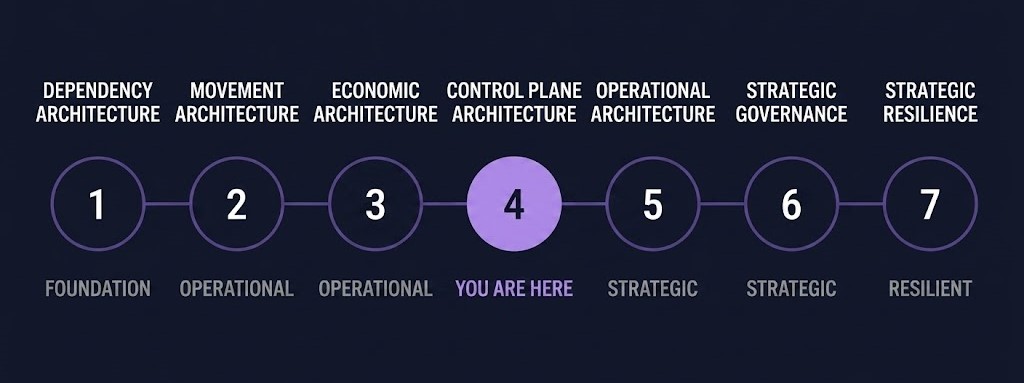
>_ Where This Stage Sits
The Cloud Architecture Path Is a Dependency-Progression Model
| Stage | Architectural Question |
|---|---|
| CS1 — Dependency Architecture | What are we dependent on? |
| CS2 — Movement Architecture | What controls our movement? |
| CS3 — Economic Architecture | What determines our economic structure? |
| CS4 — Control Plane Architecture | What governs the architecture? |
| CS5 — Operational Architecture | How is authority operationalized? |
| CS6 — Strategic Governance | Who governs authority? |
| CS7 — Strategic Resilience | How does authority survive failure? |
The first half of the path identifies constraints — dependency, movement, economics. The second half identifies authority — where it resides, how it operates, who governs it, and how it survives disruption. CS4 is the transition point between the two.
>_ Stage Reading Sequence
The sequence below is organized as a discovery process, not a technology category list. Each cluster answers: what becomes visible about authority that wasn’t visible before?
AUTHORITY DISCOVERY BEGINS HERE
Control Plane Architecture reads the architecture for where decisions actually get made — independent of where they’re documented as being made. Every stage that follows — operational execution, strategic governance, and survivability — assumes this map exists. An operational model built without it will assign runbooks to systems that can’t actually execute the decisions those runbooks describe. A governance model built without it will assign decision rights to teams that don’t hold the authority being governed.
The reading sequence begins with discovery — what’s actually deciding — and ends with diagnostics: how to find authority ambiguity before an incident finds it for you.
Architectural question: What is actually making decisions?
What is actually making decisions?
The foundational distinction this stage is built on: the system that owns a component and the system that governs its behavior are frequently not the same system. This cluster establishes how to trace a decision back to the control plane that actually made it — separating the formal ownership record from the operational reality.
Architectural question: Where has authority accumulated — and which control plane can stop the architecture?
Where has authority accumulated — and which control plane can stop the architecture?
The direct successor to CS3’s concentration discussion. Where CS3 read concentration as an economic force — the Control Plane Premium — this cluster reads it as an authority question: which single control plane, if it stopped functioning or stopped agreeing, could halt deployments, block access, or freeze the architecture in place? IAM concentration, CI/CD concentration, policy-engine concentration, SaaS concentration, and platform concentration each produce a different version of this answer.
Architectural question: How are decisions enforced — and does the enforcement match the policy?
How are decisions enforced — and does the enforcement match the policy?
A policy is a statement of intent. Enforcement is what actually happens. This cluster maps the gap between the two — where written policy and operational enforcement diverge, and what that divergence reveals about which control plane is truly authoritative. A policy that cannot be enforced at the point of decision does not govern, regardless of how it’s documented.

The Control Plane Ownership Boundary — the point where responsibility for a system diverges from authority over its operation.
>_ Authority Failure Patterns
>_ Cloud Control Plane Architecture Failure Patterns
>_ Live Diagnostics
Architectural question: What governs outside the intended architecture?
What governs outside the intended architecture?
Every architecture has an intended governance model — the one in the diagrams and the documentation. Shadow control planes are the systems that govern in practice but were never part of that model: a script that’s become load-bearing, a Slack-based approval process that overrides the formal change pipeline, a vendor’s default behavior that quietly supersedes internal policy. This cluster covers how shadow authority forms and how to find it before it becomes the explanation for an incident.
Architectural question: How do you identify authority ambiguity before an incident does?
How do you identify authority ambiguity before an incident does?
The stage’s synthesis article — a practical diagnostic process for mapping the Control Plane Ownership Boundary across an environment. Where do ownership and authority align, and where do they diverge? Which divergences are tolerable, and which are Authority-Fragmented Architecture waiting for the right incident to expose it? This is the cluster where the prior four clusters’ findings become a usable map.
>_ Authority Mapping as an Architectural Practice
Authority mapping is not a one-time audit. The control plane that governs a given decision today can change — a new policy engine is introduced, a platform team takes on a new responsibility, a vendor changes default behavior in a way that quietly becomes authoritative. An authority map produced once and never revisited has the same shelf life as the architecture diagram it was meant to replace: accurate on the day it was drawn, and progressively less true after.
The practice this stage establishes is incident-driven verification combined with periodic review. Every incident that involves a decision — an access grant, a deployment, a policy override — is an opportunity to confirm whether the system that made the call matches the system the architecture says should have made it. When it doesn’t match, that’s not necessarily a problem to fix immediately. It’s a data point about where the Control Plane Ownership Boundary actually sits, and whether the divergence is tolerable or needs to be addressed at the next stage.
Periodic review — independent of incidents — closes the gap that incident-driven verification leaves open: the decisions that go smoothly often enough that no one questions which system made them. A quarterly pass through the major decision domains (access, deployment, policy, provisioning) asking “which control plane actually decided, last time this came up” surfaces drift before it becomes the subject of a postmortem.
>_ Stage Graduates Can Now
CS1 graduates understand dependencies. CS2 graduates understand movement. CS3 graduates understand economics. CS4 graduates understand authority. They can identify which systems govern architectural decisions, distinguish ownership from control, and expose the authority structures operating beneath the documented architecture. What changes at Operational Architecture — the next stage — is the shift from mapping authority to operationalizing it: building the runbooks, lifecycle ownership, and operating models that act on the map this stage produces.
- Distinguish ownership from authority — and explain to a team why owning a system does not guarantee they govern what happens within it
- Identify the Control Plane Ownership Boundary for a given decision domain — where the formal owner and the actual decision-maker diverge
- Recognize Authority-Fragmented Architecture before an incident exposes it — multiple systems with overlapping claims and no model for resolving conflicts
- Trace the gap between documented policy and actual enforcement, and identify which control plane is truly authoritative when they diverge
- Locate shadow control planes — informal systems that have become load-bearing for governance without being part of the intended architecture
- Enter CS5 (Operational Architecture) with a working map of where authority resides — the precondition for building operating models that act on real authority rather than documented ownership
>_ Where Do You Go From Here
>_ Frequently Asked Questions
Q: What is control plane architecture?
A: Control plane architecture is the discipline of identifying which systems actually govern the behavior of a cloud environment — as distinct from which systems are formally responsible for it. It answers the stage question: what governs the architecture? The output is a map of where architectural authority resides — which systems can authorize, deny, enforce, or override decisions — independent of which teams own those systems on paper.
Q: What is the Control Plane Ownership Boundary?
A: The Control Plane Ownership Boundary (Framework #135) is the point at which responsibility for a system diverges from authority over its operation, causing architectural decisions to be governed by a different control plane than the one formally identified as the owner. Below the boundary, the system that owns a component also governs decisions made within it. Above it, the formal owner can be identified, but the decisions that matter are made — or overridden — somewhere else.
Q: What is the difference between ownership and authority?
A: Ownership is a responsibility and accounting relationship — a team’s name is on a system’s budget, uptime, and roadmap. Authority is the capacity to authorize, deny, enforce, or override a decision. A team can own a system completely and have no authority over what happens when that system interacts with the rest of the architecture, because a policy engine, gateway, or automation pipeline they don’t control actually governs that interaction. This stage is built around the gap between the two.
Q: What is Authority-Fragmented Architecture?
A: Authority-Fragmented Architecture is the named failure state for this stage — the condition where multiple systems appear to govern overlapping decisions, but no single authority model exists to explain how decisions are made, enforced, or overridden. The problem is not that multiple control planes exist; multiple control planes are normal at scale. The problem is the absence of a model describing which one prevails when their decisions conflict.
Q: Can an organization have multiple control planes?
A: Yes. The architectural problem is not multiple control planes. The problem is overlapping authority without a governing model that explains which control plane prevails when decisions conflict. An environment with one IAM system, one policy engine, and one deployment pipeline can still have Authority-Fragmented Architecture if none of those systems has a documented relationship to the others when their decisions disagree.
Q: How does Coordination Density (Framework #132) relate to this stage?
A: Coordination Density — a Framework from the AI Infrastructure pillar — describes how authority becomes increasingly difficult to identify as coordination layers (orchestration systems, policy engines, approval chains, automation frameworks) multiply between a decision and its execution. This stage does not depend on that framework, but the condition it describes is the reason CS4 exists: as those coordination layers accumulate, architectural authority becomes distributed faster than it becomes visible. CS4 picks up where that condition leaves off and asks where authority actually sits once it’s this distributed.
Q: How is this different from a security or IAM audit?
A: A security or IAM audit checks whether required controls exist and are configured correctly. This stage checks whether the controls that exist are the ones actually making decisions. A control can pass every audit checklist and still never be the deciding factor when a real decision is made — if something else overrides it, bypasses it, or operates outside its scope. This stage is concerned with that gap, not with control configuration itself.
>_ Related Systems
The prerequisite stage — the Control Plane Premium identified in CS3’s failure patterns is the economic signal this stage traces back to an authority structure.
Open Stage →The next stage — Operational Architecture builds the runbooks, lifecycle ownership, and operating models that act on the authority map this stage produces.
Open Stage →The pillar page for cloud strategy architecture — the full decision framework for dependency, movement, cost, and control plane design.
Open Pillar →Framework #132 — Coordination Density: the cross-pillar doctrine source for this stage. Explains why authority becomes difficult to identify as coordination layers multiply.
Open Post →Cross-pillar diagnostic for runtime authority and governance drift — a structural analog to the authority-mapping exercise in this stage’s diagnostics cluster.
Open Tool →The private cloud counterpart — control plane authority questions for VMware, AHV, Proxmox, and Hyper-V environments.
Open Stage →Authoritative reference for policy enforcement points and policy decision points — the architectural vocabulary underlying this stage’s enforcement-architecture cluster.
Open Reference →Reference for policy-as-code enforcement — relevant context for the policy-versus-enforcement gap covered in Cluster 03.
Open Reference →