

GOVERNANCE & RUNTIME CONTROL
Policy exists. Enforcement exists. The question is whether anyone governs execution authority.
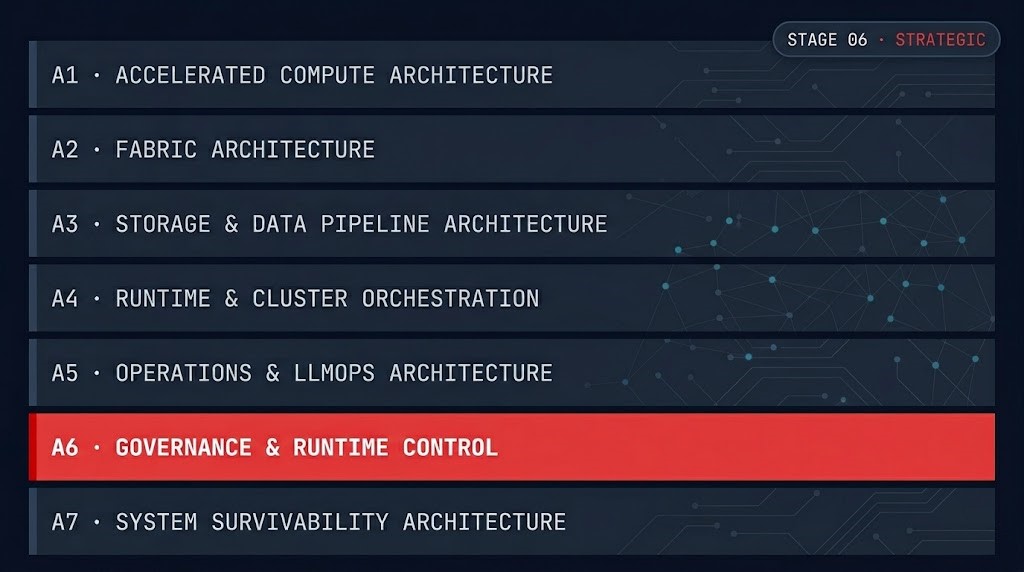
MATURITY POSITION — AI INFRASTRUCTURE STAGE 06 OF 07
- Current Stage: Strategic — Maturity Stage 06 of 07
- Primary Architectural Concern: Runtime authority ownership — who possesses the architectural authority to deny, terminate, override, and approve inference execution at the control plane layer, and whether that authority is structurally enforced or merely assumed
- Primary Failure Mode: Runtime Authority Vacuum (#123) — the condition in which policy exists, enforcement tooling exists, and operational ownership exists, but no architectural authority exists with the ability to govern execution at runtime. The result is governance theater: policy documents that don’t enforce, tools that don’t own authority, and teams that operate without the right to act
- Stage Outcome: Ability to identify Runtime Authority Vacuum conditions before they produce operational failure; ability to design governance architectures that close the gap between policy intent and runtime enforcement; ability to distinguish a governed control plane from an administered one
- Next Stage: System Survivability Architecture →
AI governance runtime control is the stage where the architectural question shifts from how execution is operated to who governs the authority to act on it. A5 established what the operational state looks like and where the Observability Boundary sits. A6 addresses the harder problem: who possesses the right to deny execution, terminate execution, override execution, and approve execution — and whether that right is architecturally enforced or only organizationally assumed.
The failure mode at this stage is not a missing tool. It is a missing authority structure. Policy authors exist. Platform operators exist. Security teams exist. Model teams exist. What is absent is a single architectural authority with the structural ability to govern execution at runtime. When that authority is absent, the control plane is not governed — it is administered. Governance theater is the result: policy documents that describe intent without enforcement, tools that observe execution without the authority to stop it, and teams that operate without the architectural right to act.
This stage covers why that condition develops, how to identify it, and what closing it requires architecturally.
WHY THIS STAGE EXISTS — RUNTIME AUTHORITY VACUUM
At A6, the question is not whether execution is observable — it is whether anyone is authorized to govern it.
A4 established who decides where execution occurs. A5 established how to observe whether execution remains within those bounds. A6 addresses what happens when the answer to A5’s question is “no” — when operational state signals a violation, drift, or escalation event and nobody has the architectural authority to act on it.
Authority fragmentation develops predictably. Control planes emerge without design — from shadow IT accumulation, from agentic AI expanding execution scope without governance scope, from tools that acquire decision-making capability without authority accountability. Policy translation fails when enforcement boundaries don’t match authority boundaries. Governance investment inverts when the platform is built before the governance model is established, making governance a retrofit rather than an architecture. The result, across all of these pathways, is Runtime Authority Vacuum: a system that operates, observes, and reports — but cannot act on what it sees.
Most organizations arrive at this stage having already built the tooling layer. The tools exist. The policies exist. What is absent is the architectural decision about who governs execution authority — and that decision cannot be deferred to the tooling layer, because tooling executes authority; it does not create it.
Stage Anchor Question
Who governs execution authority?
Stage Anchor Framework — A6
Runtime Authority Vacuum (#123)
The condition in which policy exists, enforcement tooling exists, and operational ownership exists, but no architectural authority exists with the ability to govern execution at runtime. Specifically: nobody possesses final authority to deny execution, terminate execution, override execution, or approve execution. The result is governance theater — policy without enforcement, tools without authority, operations without the right to act.
Indicators: fragmented control plane ownership · policy-to-enforcement gap · tool-led governance · escalation chains without a terminal authority · governance investment inversion
What This Stage Is Not
Not a compliance checklist. Compliance frameworks describe what policies should exist. This stage addresses whether those policies translate into runtime enforcement authority. An environment can be fully compliant on paper and still exhibit complete Runtime Authority Vacuum — policy documentation and governance architecture are different artifacts with different failure modes.
Not an observability configuration guide. A5 established what must be visible. A6 addresses who is authorized to act on what A5 surfaces. Adding more dashboards, more telemetry, and more alerting does not resolve a Runtime Authority Vacuum — it makes the vacuum more visible without closing it. Tooling is not governance architecture.
Not a vendor tooling selection exercise. OPA, Kyverno, and other policy enforcement engines appear throughout this stage as enforcement layer options — not as governance architectures. The authority model must exist before enforcement tooling is selected. Selecting enforcement tooling first is the sequence inversion that produces Policy Without Enforcement: tooling that evaluates policy against execution without the authority to stop it.
Not the security policy layer. Security policy lives at A4 — admission control, network policy, and workload isolation are runtime constraints the execution authority model establishes. A6 addresses governance architecture above the security layer: who owns the right to change the security policy, who can override it under escalation, and who governs the authority structure that security policy operates within. Security is enforced within a governance architecture; it does not replace one.
>_ Estimated Reading Depth
| Format | Count | Estimated Time | Notes |
|---|---|---|---|
| Architecture articles | 12 | ~5 hrs | Core reading sequence — all five authority-progression clusters |
| Live governance diagnostic | 1 primary + 2 upstream | ~30–45 min | ARGA — apply governance authority analysis to your environment; ISA + FPA as upstream signal sources |
| Total stage depth | 12 | ~4–6 hrs | Complete before proceeding to A7 System Survivability Architecture |
>_ Where to Enter This Stage
This stage is the right entry point if you are designing or evaluating AI infrastructure where governance architecture — not tooling selection or policy documentation — is the unresolved problem. Specifically, enter here if:
- Inference execution runs without a defined authority model for denial, termination, or override decisions
- Policy exists in documentation but has no clear enforcement owner at the runtime layer
- Teams operate AI workloads without knowing who has final authority to stop execution under escalation conditions
- The control plane was built incrementally across multiple tools, teams, or acquisitions without a governance model that spans them
- Governance investment was deferred to after platform build — tooling was selected before authority was defined
- A5’s observability signals are available but nobody is structurally authorized to act on them
Do not enter this stage expecting to resolve scheduler configuration, quota contention, or cluster admission policy — those belong to A4. And do not enter expecting to resolve observability coverage gaps — those belong to A5. Runtime authority governance cannot substitute for an absent cluster authority model, and cannot function without the observability infrastructure A5 establishes.
>_ Architecture Maturity Position
| Stage | Name | Maturity Level | Stage Question |
|---|---|---|---|
| A1 | Accelerated Compute Architecture | Foundation | How does accelerated compute behave? |
| A2 | Fabric Architecture | Operational | What constrains execution movement? |
| A3 | Storage & Data Pipeline Architecture | Operational | What constrains data movement? |
| A4 | Runtime & Cluster Orchestration | Strategic | Who decides where execution occurs? |
| A5 | Operations & LLMOps Architecture | Strategic | How is execution operated? |
| A6 ← YOU ARE HERE | Governance & Runtime Control | Strategic | Who governs execution authority? |
| A7 | System Survivability Architecture | Resilient | How does execution survive failure? |

>_ Where This Stage Sits
The AI Infrastructure Path Is a Coherent Authority Progression
| Stage | Architectural Question |
|---|---|
| A1 — Accelerated Compute Architecture | How does accelerated compute behave? |
| A2 — Fabric Architecture | What constrains execution movement? |
| A3 — Storage & Data Pipeline Architecture | What constrains data movement? |
| A4 — Runtime & Cluster Orchestration | Who decides where execution occurs? |
| A5 — Operations & LLMOps Architecture | How is execution operated? |
| A6 — Governance & Runtime Control | Who governs execution authority? |
| A7 — System Survivability Architecture | How does execution survive failure? |
A6 governs who may act. A7 determines what happens when nobody can.
>_ Stage Reading Sequence
The sequence below is organized by authority progression. Each cluster answers: what becomes architecturally unstable if this authority layer is misunderstood?
Architectural question: Who owns the right to make execution decisions?
Who owns the right to make execution decisions?
Authority does not emerge from tooling. It must be designed. In most AI environments it was not — control planes accumulated through shadow IT behavior, agentic expansion, and incremental tool adoption without a governing authority model. These three articles map the three pathways through which control plane ownership becomes structurally ambiguous: the accidental control plane nobody designed, the agentic control plane that became the authority rather than executing it, and the shadow governance that accumulates when ownership is never formally established. Together they define the precondition for Runtime Authority Vacuum (#123).
Architectural question: How does policy become enforcement?
How does policy become enforcement?
Policy and enforcement are distinct architectural layers. Policy states intent. Enforcement translates that intent into runtime decisions. The Policy Translation Boundary (#108) is the architectural surface where that translation fails — where policy exists in documentation but never reaches the enforcement layer, or where enforcement tooling operates without a policy authority that can modify it. These three articles map the translation failure modes: the authorization boundary at the model layer, the enforcement boundary mismatch when Kubernetes is assumed to govern what it cannot, and the architectural evolution from static guardrails to runtime-enforced policy that closing the translation boundary requires.
Architectural question: Who can stop execution?
Who can stop execution?
Kill authority — the architectural right to deny, terminate, or override execution — is the defining test of whether a governance architecture exists or merely a governance intention. These three articles address runtime authority from its most concrete expression outward: what happens when kill authority is delegated to machines without an authority model, how the network layer has absorbed control plane authority that was never formally assigned there, and how governance investment inverts when tooling is built before authority is defined. The third article is the stage’s densest framework piece — it introduces Governance Investment Inversion (#107) and the Policy Translation Boundary (#108) together and is the direct anchor for A6’s thesis.
>_ Governance & Runtime Control — Failure Pattern Taxonomy
Failure patterns are categorized by where authority collapses: ownership, translation, enforcement, or economics.
I. Authority Structure Failures
II. Policy & Enforcement Failures
III. Governance Drift & Investment Failures
Architectural question: What is the cost of unmanaged authority?
What is the cost of unmanaged authority?
Unmanaged authority has a cost structure. It accumulates as operational debt: unattributed spend, ungoverned execution, and infrastructure built around governance gaps rather than through them. These two articles map the economics of governance failure: how AI workloads break the cost models traditional FinOps assumes because those models were built for environments with defined ownership structures, and how autonomous operations infrastructure maturity determines whether governance investment has a surface to attach to at all. The second article introduces the operational debt accumulation model that makes Runtime Authority Vacuum an economics problem, not only an architecture problem.
Architectural question: How do you identify and close Runtime Authority Vacuum — and prepare governance structures for A7?
How do you identify and close Runtime Authority Vacuum — and prepare governance structures for A7?
Governance architecture at A6 has two destinations. The first is closing Runtime Authority Vacuum in the current environment — mapping where authority lives, identifying fragmentation, and establishing enforcement paths that connect policy to runtime action. The second is preparing governance structures that survive into A7. A7’s survivability question — how does execution survive failure? — depends on governance architecture having established what degrades gracefully and what collapses. A governance layer that was never defined at A6 has nothing to degrade at A7; it simply collapses. This article introduces the Observability Authority Boundary (#121) and establishes the handoff from A5’s visibility layer into A6’s enforcement layer that A7’s survivability architecture will inherit.
>_ Live Governance Diagnostics — AI Governance Layer
These systems surface governance authority conditions across the AI infrastructure stack. The primary tool operates at the A6 governance layer. Upstream signal tools operate at the A4/A5 layers and feed into the governance authority model. The forward bridge operates at the A7 survivability boundary.
Deterministic authority fragmentation diagnostic for AI infrastructure. Surfaces Governance Authority Rating, Operational Fragmentation Score, Runtime Control Concentration, and Governance Drift Risk. Fires Runtime Authority Vacuum when Inference Execution Authority is undefined.
>_ Open ARGA →Surfaces inference queue saturation against token throughput. Upstream signal source for governance authority review — saturation events that no authority model governs are Runtime Authority Vacuum indicators at the execution layer.
>_ Open ISA →Surfaces east-west bandwidth coupling stress across the inference cluster. Upstream signal source for governance authority review — fabric pressure events that cross authority boundaries without a governance model indicate Control Plane Fragmentation at the network layer.
>_ Open FPA →Governance decides who may act. Survivability determines what happens when nobody can. DISE models where the Survivability Boundary sits in a distributed inference architecture — the forward architectural boundary that A6’s governance model must be designed to survive.
>_ Open DISE →>_ Stage Graduates Can Now
Completing this stage closes the authority layer of the AI infrastructure maturity spine. A1 graduates understand compute. A2 graduates understand movement constraints. A3 graduates understand data constraints. A4 graduates understand execution authority. A5 graduates understand operational visibility. A6 graduates understand who governs. Earlier stages defined physical constraints and operational visibility. This stage defines the governance architecture that determines whether any of those constraints are actually enforced — and whether anyone is authorized to act when they are violated. Governance decides who may act. What A7 adds is the architecture for what happens when nobody can.
- Evaluate whether a control plane is governed or merely administered — the distinction that determines whether governance architecture exists or only governance intention
- Identify Runtime Authority Vacuum (#123) conditions before they produce operational failure — map where policy exists without enforcement, where enforcement exists without authority, and where authority exists without a terminal decision-maker
- Map policy ownership to runtime enforcement ownership — close the Policy Translation Boundary (#108) between policy intent and enforcement action at the governance layer
- Design authority escalation paths for execution denial, termination, and override decisions — establish who holds kill authority at each execution layer and under what escalation conditions it activates
- Distinguish governance architecture from operational tooling — recognize that enforcement tooling executes authority but does not create it; understand why tool selection without authority definition produces Tool-Led Governance
- Establish runtime authority models that survive organizational change — design governance structures that are architecturally durable rather than dependent on specific personnel holding informal authority
- Prepare governance structures that become survivability dependencies at A7 — A7 requires a defined governance architecture to determine what degrades gracefully; undefined authority at A6 becomes an uncontrolled collapse boundary at A7
The A6 → A7 Boundary
A6 thesis: Governance decides who may act. A7 thesis: Survivability determines what happens when nobody can. The governance architecture A6 establishes is not background infrastructure for A7 — it is the load-bearing wall. A7’s degradation ladders, failure-state envelopes, and survivability boundaries all presuppose a governance model that defined what normal execution looks like. Without A6, A7 has no baseline to degrade from.
No Specialization Tracks currently exist for the AI Infrastructure Architecture Path. Tracks are built after all seven maturity stages are live. This section will be populated as the path matures.
>_ Where Do You Go From Here
YOU’VE READ THE ARCHITECTURE.
NOW TEST WHETHER YOUR GOVERNANCE HOLDS.
Runtime authority governance is an architecture decision, not a tooling selection. Identifying whether Runtime Authority Vacuum exists in your environment requires reviewing control plane ownership, policy-to-enforcement translation, authority escalation paths, and governance fragmentation — before an operational event makes the gap visible.
Infrastructure Architecture Review
A structured review of your AI governance and runtime control architecture against the authority model this stage covers. Delivered as a written assessment with findings and remediation sequencing.
- > Runtime authority mapping — who possesses final authority to deny, terminate, and override execution
- > Policy-to-enforcement gap analysis — where the Policy Translation Boundary is open and what closes it
- > Control plane ownership assessment — fragmentation map across tools, teams, and execution surfaces
- > Governance fragmentation review — Runtime Authority Vacuum scoring and remediation sequencing
Architecture Playbooks. Field-Tested Blueprints.
Field-tested blueprints for AI governance and runtime authority architecture — covering the failure modes this stage introduces.
- > Runtime Authority Vacuum identification and remediation
- > Policy Translation Boundary architecture and enforcement path design
- > Control plane ownership mapping and governance fragmentation analysis
- > Governance drift detection and authority escalation chain design
Zero spam. Unsubscribe anytime.
>_ Frequently Asked Questions
Q: What is Runtime Authority Vacuum?
A: Runtime Authority Vacuum (#123) is the condition in which policy exists, enforcement tooling exists, and operational ownership exists, but no architectural authority exists with the ability to govern execution at runtime. Specifically: nobody possesses final authority to deny execution, terminate execution, override execution, or approve execution. The result is governance theater — policy that describes intent without enforcement, tools that observe execution without the authority to stop it, and teams that operate without the architectural right to act. Runtime Authority Vacuum is the defining failure state of A6 because it can exist in fully instrumented, fully staffed, fully documented environments. Its presence is not signaled by an absence of tooling. It is signaled by the absence of a terminal decision-maker when an execution event requires one.
Q: Why is governance an infrastructure concern rather than an organizational concern?
A: Governance is typically framed as an organizational problem — the right policies, the right teams, the right reporting structures. But in AI infrastructure, governance fails at the architectural layer before it fails at the organizational layer. Policy Translation Boundaries are architectural surfaces, not org chart gaps. Control Plane Fragmentation is an architecture state, not a management failure. Runtime Authority Vacuum exists because no execution authority was architecturally defined — not because the wrong person holds a title. Organizational governance can exist in full while architectural governance is absent. The two do not substitute for each other. What A6 addresses is the architectural precondition that organizational governance requires to function: an authority model that is structurally enforced at the execution layer, not only documented at the policy layer.
Q: What is the difference between a governed control plane and an administered one?
A: An administered control plane is managed — operators run it, tools observe it, policies describe what it should do. A governed control plane is architected — authority is defined, enforcement is structural, escalation paths exist, and someone possesses the architectural right to deny or terminate execution. The distinction matters because administration can continue indefinitely without governance. Platforms are administered. Operations run. Costs accumulate. Drift happens. But when an execution event requires a decision — deny this inference request, terminate this workload, override this policy — an administered control plane has no terminal authority to make that decision. A governed control plane does. The transition from administered to governed requires an explicit architectural decision about who holds execution authority, not an operational improvement.
Q: How does the Policy Translation Boundary (#108) differ from a policy enforcement gap?
A: A policy enforcement gap is a configuration problem — policy exists, tooling exists, but configuration errors prevent enforcement from functioning. The Policy Translation Boundary is an architectural problem: the boundary between policy intent and runtime enforcement action has not been closed at the design level. It is not that enforcement is misconfigured. It is that the architectural layer that translates policy into enforcement decisions was never built. The boundary exists where policy authors and enforcement tooling operate in separate architectural layers without a translation mechanism connecting them. Closing it requires designing the translation layer — not fixing the configuration of tools that are operating correctly within a system that was never designed to enforce the policy they are configured against.
Q: What is Governance Investment Inversion (#107) and why does it compound Runtime Authority Vacuum?
A: Governance Investment Inversion is the condition in which governance investment is deferred until after platform build — tooling and execution capacity are funded first, governance architecture second. The inversion compounds Runtime Authority Vacuum because it means every governance decision requires a platform change rather than an authority decision. When governance is designed before the platform, authority boundaries are architectural features. When it is designed after, authority boundaries are retrofit constraints that the platform resists. In practice: organizations that built AI platforms without governance architecture first now face the problem that establishing Runtime Authority Vacuum remediation requires changing the platform, not just assigning authority — which means Governance Investment Inversion converts a governance architecture problem into an infrastructure rebuild problem.
Q: How does A5 connect to A6 — what does A5 make visible that A6 then governs?
A: A5 establishes what can be seen and where the Operational Observability Boundary sits. A6 establishes who is authorized to act on what A5 surfaces — who holds enforcement rights and what the authority escalation path looks like. A5 answers: is the operational state of this execution visible? A6 answers: who is authorized to act on what is visible? A5 cannot enforce what it observes — it can surface a Runtime Authority Vacuum condition without resolving it. A6 cannot govern what A5 has not made visible — undefined observability at A5 means A6 governs blind. The two stages are co-dependent on the same observability axis: visibility without authority produces Observability-Blind Operations at A5; authority without visibility produces Runtime Authority Vacuum at A6.
Q: What makes ARGA different from standard AI observability or monitoring tools?
A: Standard observability and monitoring tools surface operational state — latency, throughput, cost, error rates. ARGA surfaces governance authority state — who owns inference execution authority, where control concentration creates fragmentation risk, what the Governance Drift Risk score is, and whether the environment exhibits the hard trigger conditions for Runtime Authority Vacuum. These are different diagnostic surfaces. A monitoring tool tells you what execution is doing. ARGA tells you whether anyone is architecturally authorized to govern what execution is doing. An environment can have complete observability coverage and complete Runtime Authority Vacuum simultaneously — the tools observe the vacuum without resolving it. ARGA is designed to make the vacuum visible as an architectural condition, not as a monitoring gap.
Q: Why does undefined governance at A6 become a survivability problem at A7?
A: A7’s survivability architecture requires a defined governance model to function. Degradation ladders — the architecture for what degrades gracefully under failure — require knowing what ‘normal’ execution looks like and who is authorized to enforce it. Failure-state envelopes require governance boundaries that define what the system is allowed to do in degraded states. Survivability boundaries require an authority model that determines what execution continues, what pauses, and what terminates when the system is under failure pressure. Without A6’s governance architecture, A7 has no baseline to degrade from and no authority model to enforce degradation decisions. Governance decides who may act. Survivability determines what happens when nobody can — but if nobody was ever authorized to act, the survivability architecture has nothing to preserve.
>_ Related Systems
Establishes the Operational Observability Boundary that A6’s enforcement layer depends on — A6 cannot govern what A5 has not made visible; undefined observability at A5 means A6 governs blind.
Open Stage →Defines the execution authority model at the cluster layer — A6’s governance architecture operates above and within the authority boundaries A4 established; undefined authority at A4 propagates upward into unresolvable governance gaps at A6.
Open Stage →Inherits A6’s governance architecture as a structural dependency — degradation ladders and failure-state envelopes require a defined authority model to function; undefined governance at A6 becomes an uncontrolled collapse boundary at A7.
Open Stage →The A6 anchor diagnostic — authority fragmentation scoring, Runtime Authority Vacuum detection, Governance Drift Risk output, and Observability Authority Exposure across your AI infrastructure environment.
Open Tool →The full AI infrastructure pillar — governance and runtime control architecture in the context of the wider AI infrastructure decision landscape.
Open Pillar →The policy enforcement engine most commonly deployed at the Policy Translation Boundary in Kubernetes-based AI environments — the enforcement layer implementation reference for the policy-to-runtime translation architecture this stage covers.
Open Reference →The NIST AI Risk Management Framework’s Govern function — the federal standard for AI governance architecture, authority assignment, and accountability structures that maps directly to the runtime authority model this stage covers.
Open Reference →