

SYSTEM SURVIVABILITY ARCHITECTURE
Governance decides who may act. Survivability determines what happens when nobody can.

MATURITY POSITION — AI INFRASTRUCTURE STAGE 07 OF 07
- Current Stage: Resilient — Maturity Stage 07 of 07
- Primary Architectural Concern: Survivability boundary definition — where the execution envelope ends under failure conditions, what degrades gracefully versus collapses, and whether the infrastructure below the governance layer can sustain inference continuity when failure exceeds the ability of any authority to act on it
- Primary Failure Mode: Survivability-Blind Architecture — the condition in which AI infrastructure is designed around steady-state execution assumptions without an explicit degradation ladder, failure-state envelope, or continuity architecture. When failure arrives, the system has no architecture that decides what survives. It does not degrade — it collapses.
- Stage Outcome: Ability to define the Survivability Boundary (#125) for an AI infrastructure environment; ability to design degradation ladders and failure-state envelopes that determine what continues, degrades gracefully, and collapses under failure conditions; ability to distinguish survivability architecture from high availability configuration
- Next Stage: Path complete — System Survivability Architecture is the final stage. Return to AI Infrastructure Architecture Path for full domain coverage.
System survivability architecture is the stage where the architectural question shifts from who governs execution to what survives when governance is no longer sufficient to act. A6 established who holds the authority to deny, terminate, and override execution at the control plane layer. A7 addresses the harder condition: what happens when that authority cannot act — when failure arrives faster than intervention, when the infrastructure degrades beyond the reach of operational response, or when the assumptions that every prior stage was built on become false simultaneously.
How does execution survive failure? That question is the final architectural test of the AI infrastructure maturity spine. The answer depends on every layer below it. Compute, fabric, data, orchestration, operations, and governance each establish constraints that determine what remains possible when the system is under failure pressure. A7 does not introduce a new layer on top of those constraints — it designs the envelope that determines what survives when they are violated.
The failure mode at this stage is not a missing redundancy configuration or an incomplete failover policy. It is a missing survivability architecture. Most AI infrastructure environments are designed around steady-state execution assumptions. Cluster provisioning assumes available capacity. Inference routing assumes reachable endpoints. Governance assumes authority can be exercised. When those assumptions become false under failure conditions, environments without an explicit Survivability Boundary have no architecture that decides what continues. They collapse rather than degrade — not because the failure was too severe, but because degradation was never designed.
WHY THIS STAGE EXISTS — SURVIVABILITY-BLIND ARCHITECTURE
At A7, the question is not whether execution is governed — it is whether execution can survive when governance fails to act in time.
A6 established who governs execution authority and what happens when that authority is absent. A7 addresses what happens when authority is present but insufficient — when failure conditions exceed the response time, reach, or capacity of every governance mechanism A6 established. The failure mode is not a governance gap. It is a survivability gap: infrastructure that operates and governs correctly under normal conditions but has no defined behavior under failure conditions that governance cannot resolve.
Survivability-Blind Architecture develops when execution design stops at steady-state assumptions. Inference routing is designed for available endpoints. Capacity planning is designed for provisioned resources. Observability is designed for operational signals rather than failure signals. The architecture functions correctly until failure arrives — at which point it has no architecture that decides what continues, what degrades gracefully, and what collapses. The absence of a degradation ladder means the system collapses to the same level regardless of failure severity. The absence of a failure-state envelope means the system cannot distinguish acceptable degraded operation from unacceptable collapse.
A7 also introduces a shift in the signal layer. Under normal operation, observability confirms that execution is proceeding. Under failure conditions, the most dangerous signals are false positives — systems that report healthy while delivering failed outcomes. Semantic outages, silent degradation, and placement recovery failure all produce environments that look operational while the Survivability Boundary is being approached. The observability architecture A5 established was designed for operational visibility. A7 requires a different signal layer: one designed to detect survivability degradation before collapse occurs.
What A7 Changes
| Stage | Question |
|---|---|
| A1 | How does accelerated compute behave? |
| A2 | What constrains execution movement? |
| A3 | What constrains data movement? |
| A4 | Who decides where execution occurs? |
| A5 | How is execution operated? |
| A6 | Who governs execution authority? |
| A7 | How does execution survive failure? |
Every previous stage assumes execution is possible. A7 assumes failure is inevitable. The architectural question is no longer whether execution can occur, but whether execution can continue when critical assumptions become false.
Stage Anchor Question
How does execution survive failure?
Stage Anchor Framework — A7
Survivability Boundary (#125)
The point at which an AI system can no longer maintain meaningful execution continuity under failure conditions, regardless of available capacity, governance controls, or operational intervention. Below the Survivability Boundary, degradation transitions to collapse — not because failure was catastrophic, but because no architecture defined what survives.
Named Failure State: Survivability-Blind Architecture · Indicators: no degradation ladder · no failure-state envelope · placement recovery absent · false-positive observability · governance-to-survivability handoff undefined
What This Stage Is Not
Not a high availability configuration guide. HA configuration addresses component redundancy within a steady-state execution model. Survivability architecture addresses the execution envelope under conditions where steady-state assumptions have failed. An environment with complete HA configuration and complete Survivability-Blind Architecture is common: redundancy keeps components available; the absence of a degradation ladder means the system collapses when multiple failure conditions arrive simultaneously. Redundancy is an input to survivability architecture, not a substitute for it.
Not a disaster recovery architecture stage. Disaster recovery addresses restoration from failure to normal operation — RTO, RPO, and the recovery sequence that returns a system to steady state. Survivability architecture addresses the operational envelope during failure — what execution continues, at what degraded level, and under what conditions collapse is preferable to continued degraded operation. DR assumes failure ends. Survivability assumes failure persists and must be operated through.
Not a governance architecture extension. A6’s governance architecture governs execution under normal and escalation conditions. A7’s survivability architecture governs execution when governance cannot act in time — when the authority model A6 established is present but too slow, too fragmented, or too dependent on infrastructure that has already failed. A7 does not replace A6; it defines what the system does when A6’s mechanisms are insufficient. Governance and survivability operate at different timescales under different failure assumptions.
Not a chaos engineering implementation guide. Chaos engineering tests whether a system behaves as expected under failure injection. Survivability architecture defines what the expected behavior under failure should be before it is tested. An environment that runs chaos engineering experiments against an architecture with no defined failure-state envelope is testing collapse rather than survivability — the experiments surface failures, but there is no designed survivability behavior to validate against. Chaos engineering is a validation mechanism for survivability architecture; it cannot substitute for the architecture itself.
>_ Estimated Reading Depth
| Format | Count | Estimated Time | Notes |
|---|---|---|---|
| Architecture articles | 12 | ~5 hrs | Core reading sequence — all five survivability clusters |
| Live survivability diagnostic | 1 primary + 3 upstream | ~45–60 min | DISE — distributed inference survivability; ARGA, ISA, FPA as upstream signal sources |
| Total stage depth | 12 | ~4–6 hrs | Final stage — complete before revisiting the full path as a coherent survivability system |
>_ Where to Enter This Stage
This stage is the right entry point if you are designing or evaluating AI infrastructure where survivability — not availability, not recovery, and not governance — is the unresolved problem. Specifically, enter here if:
- AI workloads run without a defined degradation sequence — when capacity drops or endpoints become unavailable, there is no architecture that governs what continues and what stops
- The boundary between acceptable degraded operation and unacceptable collapse has never been defined for your inference environment
- Failure-state observability is absent — operational dashboards confirm steady-state health but cannot distinguish normal operation from a system approaching the Survivability Boundary
- Inference routing and placement decisions are made for available capacity without a continuity architecture for reduced-capacity failure conditions
- A6’s governance architecture is in place, but no architecture exists for what the system does when governance cannot act in time
- The question “how does execution survive failure?” has no architectural answer in your current environment
Do not enter this stage expecting to resolve governance authority gaps — those belong to A6. And do not enter expecting to resolve disaster recovery architecture — that belongs to the Data Protection & Resiliency Path. Survivability architecture operates during failure; DR architecture restores from it. The two are complementary, not substitutes.
>_ Architecture Maturity Position
| Stage | Name | Maturity Level | Stage Question |
|---|---|---|---|
| A1 | Accelerated Compute Architecture | Foundation | How does accelerated compute behave? |
| A2 | Fabric Architecture | Operational | What constrains execution movement? |
| A3 | Storage & Data Pipeline Architecture | Operational | What constrains data movement? |
| A4 | Runtime & Cluster Orchestration | Strategic | Who decides where execution occurs? |
| A5 | Operations & LLMOps Architecture | Strategic | How is execution operated? |
| A6 | Governance & Runtime Control | Strategic | Who governs execution authority? |
| A7 ← YOU ARE HERE | System Survivability Architecture | Resilient | How does execution survive failure? |
>_ Where This Stage Sits
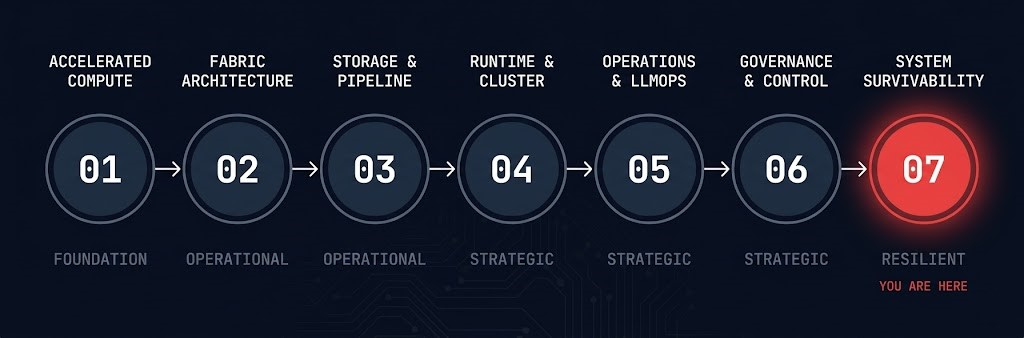
The AI Infrastructure Path Is a Coherent Authority Progression
| Stage | Architectural Question |
|---|---|
| A1 — Accelerated Compute Architecture | How does accelerated compute behave? |
| A2 — Fabric Architecture | What constrains execution movement? |
| A3 — Storage & Data Pipeline Architecture | What constrains data movement? |
| A4 — Runtime & Cluster Orchestration | Who decides where execution occurs? |
| A5 — Operations & LLMOps Architecture | How is execution operated? |
| A6 — Governance & Runtime Control | Who governs execution authority? |
| A7 — System Survivability Architecture | How does execution survive failure? |
A6 governs who may act. A7 determines what happens when nobody can.
>_ Stage Reading Sequence
The sequence below is organized by survivability progression. Each cluster answers: what becomes architecturally unstable if this survivability layer is misunderstood?
GOVERNANCE ENDS HERE
A6 established who may act. A7 establishes what survives when action is no longer sufficient. Governance assumes authority remains available. Survivability assumes authority may fail, disappear, or arrive too late. The concern shifts from control to continuity.
The reading sequence below begins where A6 ends — and answers the final question in the AI infrastructure architecture path: how does execution survive failure?
Architectural question: What does the system do when failure arrives?
What does the system do when failure arrives?
The foundation of survivability architecture is failure-state design — defining what the system does when failure arrives, rather than assuming failure will not arrive or will be resolved before it affects execution. These two articles establish the core doctrine. The first introduces the degradation ladder as a designed artifact: a sequence of execution states that the system transitions through as failure conditions worsen, ensuring collapse is a deliberate architectural decision rather than an emergent consequence of unplanned failure. The second maps the failure mode that precedes most survivability collapses — autonomous drift, the process by which systems depart from their designed operating envelope so gradually that failure arrives as a surprise rather than as a visible architectural event. Together these articles define the failure-state design foundation that every subsequent cluster in this stage depends on.
Architectural question: What survives when capacity disappears?
What survives when capacity disappears?
Execution continuity under capacity constraint is the survivability test that most AI infrastructure environments fail silently. Inference routing is designed for available endpoints; when endpoints become unavailable, routing decisions that were optimal at full capacity produce suboptimal or failed outcomes at reduced capacity. These three articles map the continuity architecture required across the capacity degradation spectrum: where inference routing decisions become placement architecture under constraint, how steady-state cost models produce survivability assumptions that fail when capacity is reduced, and how cost-aware model routing — routing inference requests to the highest-survivability endpoint rather than the highest-performance one — closes the gap between routing optimization and execution continuity. The cluster answers the practical survivability question: when the cluster loses 40% of its capacity, which execution continues? That question becomes architecturally harder when the AI control plane itself has a single-region failure domain — capacity constraint and regional failure are distinct survivability conditions that require distinct degradation ladder rungs.
Architectural question: How do you know survivability is degrading before collapse occurs?
How do you know survivability is degrading before collapse occurs?
The most dangerous survivability failures are invisible. Economic signals lag execution failure. Semantic outages — systems reporting healthy while delivering degraded or failed outcomes — produce environments that appear operational at the observability layer while the Survivability Boundary is being approached. Operational response infrastructure may not exist in a form that can consume survivability signals even when those signals are available. These three articles map the observability architecture required to detect survivability degradation before it becomes collapse: economic and execution signal lag, the deterministic observability failure that produces false confidence, and the operational response maturity that survivability signal consumption requires. Together they address the hardest observability problem in the stage: you cannot survive failure you cannot see approaching.
>_ System Survivability Architecture — Failure Pattern Taxonomy
Failure patterns are categorized by where survivability collapses: failure-state design, execution continuity, or observability.
I. Failure-State Design
II. Continuity Failure
III. Visibility Failure
Architectural question: Where are the blast radius boundaries?
Where are the blast radius boundaries?
Survivability architecture depends on blast radius boundaries — the structural isolation points that prevent failure in one execution domain from propagating to all others. Without defined blast radius boundaries, a single failure event collapses the entire execution surface rather than a bounded portion of it. These three articles map blast radius boundaries across three dimensions: geographic and network isolation for cloud-dependent AI that has no continuity architecture when cloud connectivity fails, the sovereignty layer that determines whether the AI control plane can be operated independently of the infrastructure it depends on, and the architectural reality of multi-cloud failover — why failover-as-theater produces false survivability confidence and what blast-radius-aware distribution architecture requires instead. Together they define the structural preconditions that make degradation ladders operable across distributed execution environments.
Architectural question: What does A6’s governance model hand to A7 — and what does A7 require it to have defined?
What does A6’s governance model hand to A7 — and what does A7 require it to have defined?
Survivability architecture does not begin at the Survivability Boundary — it begins at the governance layer that A6 established. The observability infrastructure A5 built, the authority model A6 defined, and the enforcement boundaries A6 closed all become structural inputs to A7’s survivability architecture. A governance layer that was never defined at A6 has nothing to degrade at A7; it collapses. A governance layer that was defined but never connected to a survivability architecture becomes a governance input to a system with no survivability output. This article closes that handoff: it introduces the Observability Authority Boundary (Framework #121) as the architectural bridge between A5’s visibility layer, A6’s enforcement model, and A7’s survivability envelope — the specific point where observability crosses from monitoring into governance enforcement and from governance enforcement into survivability architecture.
>_ Live Survivability Diagnostics — AI Infrastructure Stack
A7 is the first stage where every prior diagnostic signal converges. Each tool below surfaces a different layer of the survivability envelope — the primary tool surfaces survivability state directly; the upstream tools surface the authority, saturation, and fabric pressure signals that feed into it. Every previous signal becomes survivability input.
The A7 anchor diagnostic — models where the Survivability Boundary sits in a distributed inference architecture. Surfaces the AI Inference Survivability Chain (Framework #124), failure-state envelope position, and execution continuity path under degraded capacity conditions.
>_ Open DISE →The A6 governance diagnostic — upstream survivability input. Runtime Authority Vacuum conditions at A6 become undefined governance-to-survivability handoffs at A7: governance that cannot act becomes the first survivability constraint the failure-state envelope must account for.
>_ Open ARGA →Surfaces inference queue saturation against token throughput. Upstream survivability signal — saturation events indicate the execution envelope is approaching capacity constraints that become Survivability Boundary pressure under failure conditions.
>_ Open ISA →Surfaces east-west bandwidth coupling stress across the inference cluster. Upstream survivability signal — fabric pressure events that approach coupling limits indicate the distribution architecture’s blast radius boundaries are under stress before a failure event isolates them.
>_ Open FPA →>_ Stage Graduates Can Now
Completing this stage closes the AI Infrastructure Architecture Path. You can now reason about infrastructure beyond normal operation. You understand where execution continues, where it degrades, and where it collapses — and you understand the architectural decisions that determine which outcome follows from which failure condition. Earlier stages defined compute, movement, data, authority, operations, and governance. This stage defines the survivability envelope that remains when those systems encounter failure. Survivability is not a separate discipline layered on top of AI infrastructure. It is the cumulative result of every architectural decision that preceded it.
- Define the Survivability Boundary (#125) for a distributed inference environment — identify the point at which the system can no longer maintain meaningful execution continuity regardless of governance intervention, and design the failure-state envelope around it
- Design degradation ladders that determine what continues, degrades gracefully, and collapses under failure conditions — convert steady-state execution architecture into a failure-state execution sequence
- Identify Survivability-Blind Architecture conditions before failure makes them visible — map where steady-state assumptions have been embedded as execution requirements without a failure-state variant
- Distinguish semantic outages from operational failures — recognize the false-positive survivability conditions where systems report healthy while approaching the Survivability Boundary, and design observability architecture that detects survivability degradation before collapse
- Map blast radius boundaries in distributed inference environments — determine where failure isolation exists architecturally versus where it is assumed to exist operationally but has never been tested against real failure conditions
- Close the governance-to-survivability handoff — ensure A6’s authority model is connected to A7’s failure-state envelope in a way that survivability architecture can inherit: defined governance boundaries become defined degradation boundaries
- Apply every upstream diagnostic signal — saturation, fabric pressure, governance authority, and survivability boundary position — as a coherent survivability picture rather than independent operational metrics
The Final Architectural Question
How does execution survive failure? The answer depends on every layer of the AI infrastructure stack. Compute determines what can run. Fabric determines where it can move. Storage determines what data it can reach. Orchestration determines who decides where it runs. Operations determines how it is observed. Governance determines who is authorized to act on what is observed. Survivability determines what remains possible when each of those layers fails. The path is complete when the answer to that question is architectural rather than operational — designed rather than hoped for.
The Path Complete
| Stage | Name | Question |
|---|---|---|
| A1 | Accelerated Compute Architecture | How does accelerated compute behave? |
| A2 | Fabric Architecture | What constrains execution movement? |
| A3 | Storage & Data Pipeline Architecture | What constrains data movement? |
| A4 | Runtime & Cluster Orchestration | Who decides where execution occurs? |
| A5 | Operations & LLMOps Architecture | How is execution operated? |
| A6 | Governance & Runtime Control | Who governs execution authority? |
| A7 | System Survivability Architecture | How does execution survive failure? |
System Survivability Architecture is the final stage because survivability depends on every layer below it. Compute, fabric, data, orchestration, operations, and governance each establish constraints that determine what remains possible during failure. Survivability is not a separate discipline layered on top of infrastructure. It is the cumulative result of every architectural decision that came before it.
>_ Where Do You Go From Here
YOU’VE READ THE ARCHITECTURE.
NOW TEST WHETHER YOUR SURVIVABILITY HOLDS.
System survivability architecture is a design decision, not a configuration option. Identifying where the Survivability Boundary sits in your environment — and whether a degradation ladder exists to operate through failure conditions rather than collapse under them — requires reviewing failure-state design, execution continuity architecture, observability signal coverage, and blast radius isolation before a failure event makes the gaps visible.
Infrastructure Architecture Review
A structured review of your AI survivability architecture against the failure-state model this stage covers. Delivered as a written assessment with findings and remediation sequencing.
- > Survivability boundary assessment — where the Survivability Boundary sits and whether degradation architecture exists below it
- > Degradation ladder validation — whether a designed execution sequence exists for failure conditions or collapse is the only outcome
- > Failure-state envelope mapping — what the system is designed to do under each class of failure condition
- > Distributed inference continuity review — blast radius boundaries, placement recovery paths, and semantic outage exposure
Architecture Playbooks. Field-Tested Blueprints.
Field-tested blueprints for AI survivability architecture — covering the failure modes this stage introduces and the design patterns that close them.
- > Survivability Boundary definition and degradation ladder design
- > Failure-state envelope mapping and execution continuity architecture
- > Semantic outage detection and observability-under-failure design
- > Blast radius boundary architecture for distributed inference environments
Zero spam. Unsubscribe anytime.
>_ Frequently Asked Questions
Q: How does execution survive failure?
A: How does execution survive failure? That question has an architectural answer only when three conditions are met. First, the Survivability Boundary (#125) is defined — the point at which the system can no longer maintain meaningful execution continuity under failure conditions is identified, not discovered. Second, a degradation ladder exists — a designed sequence of execution states the system transitions through as failure conditions worsen, so that collapse is an architectural decision rather than an emergent consequence of failure arriving without a designed response. Third, failure-state observability is present — the system can detect survivability degradation before collapse occurs, rather than confirming healthy operation until the Survivability Boundary is crossed and collapse is already in progress. Without these three conditions, execution survives failure only by accident — because the specific failure combination encountered did not exceed the capacity of a system designed for steady-state operation.
Q: What is the Survivability Boundary (#125) and how does it differ from an SLA or availability target?
A: The Survivability Boundary is the point at which an AI system can no longer maintain meaningful execution continuity under failure conditions, regardless of available capacity, governance controls, or operational intervention. An SLA or availability target defines an operational commitment: the system will maintain X% uptime or recover within Y minutes. The Survivability Boundary defines an architectural limit: below this point, no operational intervention can restore execution continuity because the architectural preconditions for execution have failed. SLAs assume the infrastructure can be returned to steady state. The Survivability Boundary identifies when that assumption becomes false. An environment can meet its SLA targets under normal failure conditions and still have an undefined Survivability Boundary — the SLA describes performance under managed failure; the Survivability Boundary describes behavior under unmanaged failure.
Q: What is Survivability-Blind Architecture and why is it the named failure state rather than a configuration error?
A: Survivability-Blind Architecture is the condition in which AI infrastructure is designed around steady-state execution assumptions without an explicit degradation ladder, failure-state envelope, or continuity architecture. It is the named failure state — rather than a configuration error — because it describes an architectural condition rather than an operational mistake. A configuration error is correctable within the existing architecture. Survivability-Blind Architecture requires a different architecture: one that designs for failure states rather than assuming they will not occur or will be resolved before they affect execution. The naming convention matches the AI Infrastructure path pattern: Fabric-Blind Architecture (A2), Data-Blind Architecture (A3), Authority-Blind Orchestration (A4), Runtime Authority Vacuum (A6). Each names the architectural condition in which a critical design consideration was omitted — not a failure that happened, but a design that never existed.
Q: How does the degradation ladder differ from a failover configuration?
A: A failover configuration addresses a specific failure scenario: when component A fails, switch to component B. It describes a binary transition between two states — operational and failed-over — with the assumption that the failed-over state is functionally equivalent to the original. A degradation ladder addresses the full failure spectrum: a designed sequence of execution states that the system transitions through as failure conditions worsen, where each state defines what execution continues, at what degraded level, and under what conditions the next degradation step is triggered. A failover configuration assumes a single failure type and a single recovery state. A degradation ladder designs for multiple failure types, multiple degraded states, and explicit criteria for when degradation transitions to collapse. An environment can have complete failover configuration and complete Degradation Ladder Absence simultaneously — the failover handles the specific failure it was designed for; the absence of a degradation ladder means compound or unexpected failure produces collapse rather than managed degradation.
Q: What is a semantic outage and why is it the most dangerous survivability failure mode?
A: A semantic outage is the condition in which systems return success signals — HTTP 200, operational status green, health checks passing — while delivering failed or degraded outcomes. The requests succeed at the protocol layer but fail at the semantic layer: the model returns a coherent response that is factually incorrect, the inference result is delivered at unacceptable latency, or the output is generated from a degraded execution path that no longer meets the quality threshold the system was designed to enforce. Semantic outages are the most dangerous survivability failure mode because they eliminate the signal that would trigger a governance or operational response. Binary failures — 500 errors, timeouts, unreachable endpoints — are visible to observability infrastructure designed for operational monitoring. Semantic failures are invisible to that same infrastructure. The system reports healthy; the Survivability Boundary is being approached; no intervention occurs because no signal indicates that intervention is required.
Q: What is the relationship between A6’s governance architecture and A7’s survivability architecture?
A: A6’s governance architecture governs execution under normal and escalation conditions — it defines who holds execution authority, how policy translates to enforcement, and what the escalation path looks like when execution requires a governance decision. A7’s survivability architecture governs execution when governance cannot act in time — when failure conditions exceed the response time, reach, or capacity of the governance mechanisms A6 established. The two stages are sequential dependencies, not alternatives. A governance layer that was never defined at A6 has nothing to degrade at A7; the governance-to-survivability handoff is undefined, which means survivability architecture cannot inherit a governance baseline to design around. A governance layer that was defined at A6 but never connected to a survivability architecture becomes a governance input to a system with no survivability output. The Observability Authority Boundary (#121) is the specific architectural bridge between them — the layer where observability crosses from governance enforcement into survivability architecture.
Q: How does DISE differ from ISA, ARGA, and FPA as survivability diagnostics?
A: ISA, ARGA, and FPA surface upstream survivability signals — conditions at the saturation, governance authority, and fabric pressure layers that become survivability constraints when failure conditions arrive. They answer: what is the current state of the inputs that determine survivability? DISE surfaces survivability state directly — it models where the Survivability Boundary sits in a distributed inference architecture given the upstream signal state, and maps the execution continuity path under degraded capacity conditions. The distinction matters because an environment can have acceptable saturation, governance authority, and fabric pressure readings while still exhibiting a low Survivability Boundary — because survivability depends on the designed failure-state architecture, not only on the current operational state. DISE is the tool that makes the Survivability Boundary visible as an architectural condition rather than as an aggregation of upstream metrics.
Q: Why is System Survivability Architecture the final stage of the AI Infrastructure path?
A: System Survivability Architecture is the final stage because survivability depends on every layer below it. Each prior stage establishes a constraint layer that survivability architecture must account for: compute determines what can run under failure conditions, fabric determines where execution can move, storage determines what data remains accessible, orchestration determines who decides where execution goes, operations determines what is visible, governance determines who is authorized to act. Survivability determines what remains possible when each of those constraint layers is violated simultaneously. No earlier stage can be skipped without creating a gap in the survivability architecture — Fabric-Blind Architecture at A2 means fabric failure produces an undefined survivability boundary; Runtime Authority Vacuum at A6 means governance failure removes the authority model that survivability architecture depends on to define what degrades gracefully. Survivability is not a layer added on top of AI infrastructure. It is the cumulative result of every architectural decision that preceded it.
>_ Related Systems
A7’s immediate upstream dependency — defines the authority model, Policy Translation Boundary, and governance investment architecture that survivability architecture inherits as its first structural constraint. Undefined governance at A6 becomes undefined survivability at A7.
Open Stage →The A7 anchor diagnostic — models Survivability Boundary position, failure-state envelope, and execution continuity paths for distributed inference architectures. Surfaces Framework #124 (AI Inference Survivability Chain) as the primary diagnostic output.
Open Tool →Establishes the Operational Observability Boundary — the visibility layer A7’s survivability signal architecture must extend beyond. Operational observability confirms steady-state execution; survivability observability detects degradation toward the Survivability Boundary.
Open Stage →The architectural condition that makes regional failure a distinct survivability problem from capacity constraint — when the AI control plane itself is regionally scoped, the Survivability Boundary is lower than distribution architecture suggests.
Open Post →The full AI infrastructure pillar — survivability architecture in the context of the complete AI infrastructure decision landscape across compute, fabric, data, orchestration, operations, and governance.
Open Pillar →The DR and recovery architecture sister path — where A7’s failure-state architecture ends, Data Protection’s recovery architecture begins. Survivability operates during failure; DR restores from it. The two are complementary structural dependencies, not alternatives.
Open Domain Path →The discipline for validating survivability architecture through controlled failure injection — requires a defined survivability architecture to have value; tests whether the designed degradation behavior holds under real failure conditions.
Open Reference →The foundational SRE framework for reliability, error budgets, and graceful degradation — the operational foundation that survivability architecture builds on for AI infrastructure environments where AI-specific failure modes extend beyond traditional SRE scope.
Open Reference →