

ECONOMIC ARCHITECTURE
What determines our economic structure? — The Operational Stage of Cloud Strategy

MATURITY POSITION — CLOUD ARCHITECTURE STAGE 03 OF 07
- Current Stage: Operational — Maturity Stage 03 of 07
- Primary Architectural Concern: Reading egress charges, idle capacity, reservation commitments, and exit premiums as architectural evidence — identifying the point at which accumulated placement, dependency, and movement decisions begin exerting economic force that constrains future architecture rather than informing it
- Primary Failure Mode: Economic-Blind Architecture — the condition where cost is measured as a billing outcome rather than modeled as a consequence of dependency, movement, and control-plane decisions
- Stage Outcome: Ability to identify the Economic Gravity Boundary for a given workload; ability to distinguish between cost visibility and cost control; ability to model whether a placement or platform decision remains architecturally free or has become economically constrained
- Next Stage: CS4 — Control Plane Architecture — Who owns the control plane?
Cloud economic architecture is the operational discipline that reads the cost structures produced by the dependency and movement decisions mapped in the prior two stages — the egress charges, idle capacity, reservation commitments, and exit premiums that determine whether a workload’s economics remain architecturally negotiable or have hardened into a constraint on every future decision.
The conventional treatment of cloud cost frames it as a finance question: how do we reduce the bill? That framing is architecturally backwards. By the time a cost reduction initiative is launched, the structural causes of that cost — where workloads were placed, what they depend on, what it would cost to move them — were set months or years earlier. Economic architecture does not optimize the bill. It reads the bill as evidence of the architecture that produced it, and asks whether that architecture still serves the organization or has become the thing constraining its options.
The difference between an organization that can model a repatriation or platform-change decision on its economic merits and one that discovers the decision was already made — by the accumulated weight of egress load, reservation lock, and idle drag — is not financial discipline. It is whether the Economic Gravity Boundary was identified before it became deterministic.
WHY THIS STAGE EXISTS — ECONOMIC-BLIND ARCHITECTURE
At this Operational stage, the question is not whether cost matters — it is whether the architecture can explain why the cost exists before a renewal, repatriation evaluation, or platform decision forces the explanation.
Cost signals are not visible on architecture diagrams. Egress charges are billing line items until they become the dominant force preventing a workload from moving. Idle capacity is reported as a utilization metric until someone asks why it has persisted for eighteen months and discovers the provisioning decision was never subject to governance review. Reservation commitments are a pricing optimization until a workload outgrows its committed tier and the commitment becomes a placement lock. Exit premiums are theoretical until a repatriation business case is built and the migration cost line exceeds the projected savings — not because the destination is wrong, but because the cost of leaving was never modeled at the time the architecture was built.
The Economic Gravity Boundary (Framework #131) marks the point at which these forces are read as architectural evidence before they constrain a decision already in motion. Below the boundary: cost signals are visible but uninterpreted — the organization has dashboards, not architectural intelligence. Above it: every cost signal is read for what it reveals about topology, governance, and placement, and that reading becomes an input to the next decision rather than an explanation for the last one.
How Economic Architecture Anchors the Full Path
| Stage | Name | Question |
|---|---|---|
| 01 | Dependency Architecture | What are we dependent on? |
| 02 | Movement Architecture | What controls our movement? |
| 03 | Economic Architecture | What determines our economic structure? |
| 04 | Control Plane Architecture | Who owns the control plane? |
| 05 | Operational Architecture | How is the control plane operated? |
| 06 | Strategic Governance | Who governs strategic authority? |
| 07 | Strategic Resilience | How does the architecture survive dependency failure? |
Dependency Architecture maps what exists. Movement Architecture maps what those dependencies prevent. Economic Architecture reads what those movement constraints cost — and identifies the point at which that cost stops being a number on an invoice and starts being the deciding factor in every placement decision that follows.
Stage Anchor Framework — Economic Architecture
Economic Gravity Boundary (#131)
The threshold at which prior architectural decisions — dependency concentration, movement constraints, and control-plane commitments — exert sufficient economic force that future placement and platform decisions are constrained by investment physics rather than architectural merit. Below the boundary: placement decisions remain architectural choices, evaluated on merit. Above it: egress load, reservation lock, idle drag, and exit premium combine to make movement economically irrational even when it remains technically possible.
Named Failure State: Economic-Blind Architecture · Indicators: egress charges treated as volume problems · idle capacity normalized as overhead · reservation commitments made without exit modeling · cost visibility mistaken for cost control · renewal chosen because alternatives were never priced
Why Architects Misjudge Cloud Economics
Cost visibility means cost control. Visibility tools — cost explorers, tagging dashboards, anomaly alerts — make spend legible. Legibility is not interpretation. An organization can see exactly where every dollar went and still have no model for why the architecture required that spend, whether the spend is structural or optional, or what changes if a workload moves. Visibility answers “where did the money go.” Economic architecture answers “why did the architecture require it to go there” — and only the second question informs a decision.
Reservations and savings plans are pure cost optimization. A reservation is a pricing instrument and a placement commitment at the same time. The pricing benefit is real and immediate. The placement commitment is deferred and often unmodeled — it converts a workload’s location from an architectural choice into an economic anchor for the duration of the term. When the workload’s requirements change before the term ends, or when a repatriation case becomes compelling, the reservation that looked like savings becomes the reason the alternative is too expensive to pursue. The discount was real. So is the lock.
Idle resources are an operational cleanup item. Idle capacity is treated as a tactical problem — find the unused instances, resize the over-provisioned volumes, delete the orphaned load balancers. That framing is correct at the resource level and incomplete at the architectural level. Idle capacity that persists for months is not a cleanup backlog. It is evidence that the provisioning decision and the utilization accountability sit with different authorities — and that gap will keep producing idle resources at the same rate after this cleanup as before it, because the structural cause was never addressed.
What This Stage Is Not
Not FinOps certification training. This stage does not teach reserved instance mechanics, savings plan structures, or tagging taxonomy. It teaches how those mechanisms become architectural constraints — the condition that emerges when a pricing decision hardens into a placement decision that constrains the architecture going forward.
Not a cost-cutting initiative. The output of this stage is not a list of savings opportunities. It is a model of which costs are structural — produced by dependency and movement decisions already made — and which are operational, meaning they can change without an architectural decision. Cutting a structural cost without changing the architecture that produces it does not produce savings. It produces Optimization Theater: the bill drops temporarily and reasserts.
Not a procurement or vendor negotiation framework. Provider pricing is an input to this stage, not its output. The architectural response to that pricing — how it shapes workload placement, reservation strategy, and the economic side of movement decisions — is what this stage produces. Negotiating a better rate on a cost structure that is itself a constraint does not remove the constraint.
Not Control Plane Architecture (CS4). This stage covers the economic dimension of control plane concentration — the cost premium that vendor or platform authority creates. CS4 covers who has the authority to act on that reality. A platform team consolidating infrastructure decisions produces an economic signal this stage can read; whether that team should hold that authority, and what governs it, is the next stage’s concern.
>_ Estimated Reading Depth
| Format | Count | Estimated Time | Notes |
|---|---|---|---|
| Architecture articles | 4 | ~2.5 hrs | Core reading sequence — cost visibility vs. control, exit cost as a first-class metric, egress as architectural evidence, repatriation calculus |
| Live economic diagnostic | 3 | ~45–60 min | CECA, CCA, CRE — Cloud Egress Cost Analyzer, Cloud Idle Resource Analyzer, Cloud Repatriation Economics Engine; together form the Economic Gravity Assessment |
| Total stage depth | 4 | ~3–4 hrs | Operational stage — complete after Movement Architecture; economic gravity components map directly onto the movement constraint inventory CS2 produces |
>_ Where to Enter This Stage
This stage is the correct entry point if cost is discussed in your organization primarily as a finance topic — or if cost reduction initiatives keep producing temporary savings that reassert within a quarter. Specifically, enter here if:
- Egress charges are reviewed as a billing category rather than traced to the specific cross-boundary traffic pattern producing them
- Idle capacity has been flagged in cost reports for more than one review cycle without a governance-level explanation for why it persists
- Reservation or savings plan commitments were made without modeling what happens if the workload’s placement requirements change before the term ends
- A repatriation or platform-change business case has stalled because the migration cost line item keeps exceeding the projected savings, and no one has separated which costs are structural versus which are sunk
- Cost optimization initiatives reduce the bill temporarily and the reduction does not hold past one or two billing cycles
- You have completed Movement Architecture (CS2) and have a movement constraint inventory, but have not yet translated those constraints into an economic model
Do not enter this stage expecting a cost reduction roadmap — that is a downstream output, not the stage’s purpose. And do not enter expecting a control plane governance framework — that belongs to Control Plane Architecture (CS4). Economic Architecture answers one question: what determines our economic structure? The answer to that question determines what every subsequent stage can model about control plane authority, operational governance, and strategic resilience.
>_ Architecture Maturity Position
| Stage | Name | Maturity Level | Stage Question |
|---|---|---|---|
| CS1 | Dependency Architecture | Foundation | What are we dependent on? |
| CS2 | Movement Architecture | Operational | What controls our movement? |
| CS3 ← YOU ARE HERE | Economic Architecture | Operational | What determines our economic structure? |
| CS4 | Control Plane Architecture | Strategic | Who owns the control plane? |
| CS5 | Operational Architecture | Strategic | How is the control plane operated? |
| CS6 | Strategic Governance | Strategic | Who governs strategic authority? |
| CS7 | Strategic Resilience | Resilient | How does the architecture survive dependency failure? |
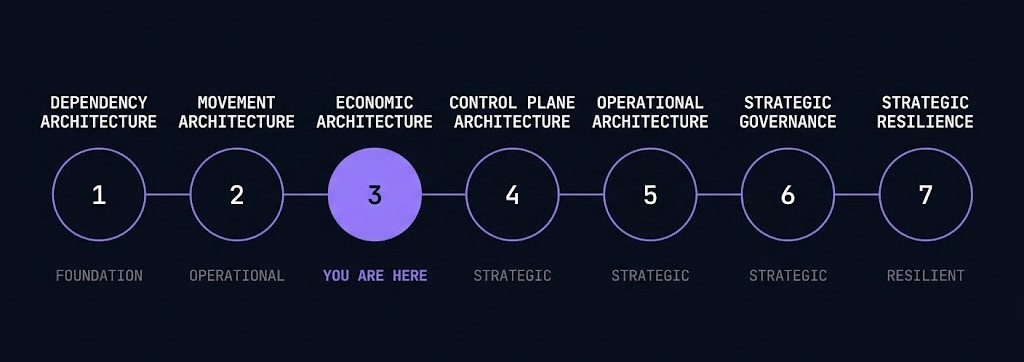
>_ Where This Stage Sits
The Cloud Architecture Path Is a Dependency-Progression Model
| Stage | Architectural Question |
|---|---|
| CS1 — Dependency Architecture | What are we dependent on? |
| CS2 — Movement Architecture | What controls our movement? |
| CS3 — Economic Architecture | What determines our economic structure? |
| CS4 — Control Plane Architecture | Who owns the control plane? |
| CS5 — Operational Architecture | How is the control plane operated? |
| CS6 — Strategic Governance | Who governs strategic authority? |
| CS7 — Strategic Resilience | How does the architecture survive dependency failure? |
Dependency Architecture maps what exists. Movement Architecture maps what those dependencies prevent. Economic Architecture reads what those movement constraints cost — and identifies when that cost has become the architecture’s deciding factor.
>_ Stage Reading Sequence
The sequence below is organized by economic question, not by technology category. Each cluster answers: what becomes economically unstable if this is misunderstood?
ECONOMIC FORCE MAPPING BEGINS HERE
Economic Architecture reads what the movement constraint profile built in Movement Architecture costs. Every stage that follows — control plane ownership, operational governance, strategic authority, and dependency survivability — assumes economic forces are understood. A control plane architecture built without economic gravity modeling will govern decisions whose costs were never read correctly. A strategic governance model built without this stage will set policy on a cost structure no one can explain.
The reading sequence begins with the visibility-versus-control distinction — the most commonly skipped foundation — and ends with the repatriation calculus, where economic gravity is tested against an actual movement decision.
Architectural question: Can you see where economic force originates — and does seeing it mean you control it?
Can you see where economic force originates — and does seeing it mean you control it?
The foundational distinction this stage is built on: visibility and control are different architectural capabilities, and most organizations achieve the first without the second. Cost Visibility Is Not Cost Control establishes why a fully-tagged, fully-dashboarded environment can still produce cost surprises — because visibility shows where money went without explaining why the architecture required it to go there.
Architectural question: Which architectural decisions are creating irreversible cost pressure?
Which architectural decisions are creating irreversible cost pressure?
This is where the Economic Gravity Boundary lives. Exit Cost as a First-Class Metric makes the case for modeling the cost of leaving before the decision to stay is even made — the architectural argument that exit premium is not a migration-time surprise but a continuously-tracked metric. Cloud Egress Costs Explained then grounds that argument in the largest and most underestimated component of economic gravity: egress as a recurring topology tax, not a one-time migration cost.
Architectural question: When economic gravity meets an actual movement decision, what is the result?
When economic gravity meets an actual movement decision, what is the result?
The Repatriation Calculus is the stage’s synthesis article — the point where economic gravity (egress load, reservation lock, idle drag, exit premium) is tested against a real placement decision. An architecture that can model repatriation viability has read its economic gravity correctly. One that cannot is operating below the Economic Gravity Boundary on at least one force, and the repatriation case will fail for reasons no one can articulate.

>_ Framework #131 — The Economic Gravity Boundary
Framework #131 — Economic Gravity Boundary
The Economic Gravity Boundary is the threshold at which prior architectural decisions — dependency concentration, movement constraints, and control-plane commitments — exert sufficient economic force that future placement and platform decisions are constrained by investment physics rather than architectural merit.
The framework identifies four force components that accumulate toward the boundary. Each is individually manageable. Combined, and unmodeled, they determine whether a placement decision remains a choice or becomes an inevitability:
Failure state: Economic-Blind Architecture — the condition in which cost is measured as a billing outcome rather than modeled as a consequence of dependency, movement, and control-plane decisions. The organization has cost visibility but not economic architecture awareness.
The boundary is not fixed. Every new workload placement, every reservation renewed, every dataset that grows, and every traffic pattern that becomes permanent changes the gravity profile for the workloads it touches. Economic architecture is not a quarterly cost review. It is a continuous practice of reading egress, reservation, idle, and exit signals as they accumulate — so that the Economic Gravity Boundary is identified while a placement decision is still a choice, not after it has become the explanation for why no other choice was possible.
>_ The Economic Force Map
Cost is not the root variable in cloud architecture. It is the output variable — the final term in a chain of decisions that begins with dependency and ends with the strategic options an organization has left. The Economic Force Map makes that chain visible.
Each stage in the Cloud Architecture Path adds a term to this chain. Dependency Architecture (CS1) establishes what a workload is connected to. Movement Architecture (CS2) establishes what those connections cost to undo. Economic Architecture (CS3) reads what that undoing-cost compounds into — and Control Plane Architecture (CS4) adds the governance premium that authority concentration layers on top. What remains at the end of the chain is the set of strategic options the organization actually has — which is frequently smaller than the set of options it believes it has, because the chain was never read in order.

>_ The Diagnostic Reframe
SIGNAL — EGRESS CHARGE SPIKE
Reframe: which topology decision created this cross-boundary dependency?
The charge is not a volume problem to negotiate. It is the bill making a placement decision visible — a service is communicating across a boundary it was not designed around.
SIGNAL — IDLE RESOURCE COST
Reframe: which provisioning decision was made without utilization accountability?
Idle cost is a governance signal. It persists not because anyone is careless, but because provisioning authority and utilization accountability sit in different places.
SIGNAL — RESERVATION LOCK
Reframe: which placement commitment was made before the architecture was stable?
The discount was a pricing choice. The lock that activates when requirements change is an architectural constraint that was accepted as a side effect.
SIGNAL — REPATRIATION CASE THAT KEEPS FAILING REVIEW
Reframe: have we crossed the Economic Gravity Boundary on this workload?
If the migration cost line keeps exceeding projected savings regardless of how the case is rebuilt, the four gravity forces have likely already determined the outcome — the case is failing for structural reasons, not presentation reasons.
>_ Economic Failure Patterns
>_ Cloud Economic Architecture Failure Patterns
>_ Live Diagnostics
>_ Stage Graduates Can Now
You now have the analytical vocabulary for reading cost as architectural evidence. What changes at Control Plane Architecture — the next stage — is the shift from reading economic signals to governing the authority that produces them. Control Plane Architecture addresses who has the power to make the placement, reservation, and provisioning decisions this stage taught you to read — and what happens when that authority is concentrated, fragmented, or misaligned with the economic consequences it produces.
- Distinguish between cost visibility and cost control — and explain to leadership why achieving one does not produce the other
- Read egress charges, idle capacity, and reservation commitments as architectural evidence rather than billing line items to optimize
- Identify the Economic Gravity Boundary for a given workload and determine whether a placement or platform decision remains architecturally free or has become economically constrained
- Recognize Optimization Theater — savings initiatives that reduce spend without addressing the structural cause — before committing resources to them
- Model a repatriation or platform-change business case using the four gravity forces, separating structural cost from sunk cost
- Enter CS4 (Control Plane Architecture) with a working model of where economic force originates in the current architecture — and which control plane authority decisions will require economic justification to make
>_ Where Do You Go From Here
>_ Frequently Asked Questions
Q: What is cloud economic architecture?
A: Cloud economic architecture is the operational discipline that reads cost structures — egress charges, idle capacity, reservation commitments, and exit premiums — as architectural evidence rather than billing events. It identifies the point at which accumulated dependency, movement, and control-plane decisions begin exerting economic force that constrains future architecture rather than informing it. It answers the stage question: what determines our economic structure?
Q: What is the Economic Gravity Boundary?
A: The Economic Gravity Boundary (Framework #131) is the threshold at which prior architectural decisions — dependency concentration, movement constraints, and control-plane commitments — exert sufficient economic force that future placement and platform decisions are constrained by investment physics rather than architectural merit. Below the boundary, placement decisions remain architectural choices. Above it, four forces — Egress Load, Reservation Lock, Idle Drag, and Exit Premium — combine to make movement economically irrational even when it remains technically possible.
Q: What is the difference between cost visibility and cost control?
A: Cost visibility means an organization can see where money was spent — dashboards, tagging, cost explorers all produce visibility. Cost control means the organization understands why the architecture required that spend and can change it. Visibility answers ‘where did the money go.’ Control answers ‘why did the architecture require it to go there, and what changes if we alter the architecture.’ An organization can have full visibility and zero control — which is the Economic-Blind Architecture failure state.
Q: What is Economic-Blind Architecture?
A: Economic-Blind Architecture is the named failure state for this stage — the condition in which cost is measured as a billing outcome rather than modeled as a consequence of dependency, movement, and control-plane decisions. The organization has cost visibility but no architectural interpretation layer: the signals are present, but nothing converts them into input for the next decision.
Q: What is Optimization Theater?
A: Optimization Theater is a cost architecture failure pattern where savings initiatives — rightsizing, reserved instance adjustments, tag enforcement campaigns — reduce spend without addressing the structural cause that produced it. The bill drops for one or two billing cycles and then reasserts, because the architecture that generated the cost was never changed. Optimization Theater is the predictable result of treating cost as a finance problem rather than an architecture problem.
Q: When does it make economic sense to repatriate cloud workloads?
A: Repatriation makes economic sense when the total cost of the destination — capital, operational, licensing, staffing — falls below the current cloud cost structure over the same period, net of migration costs. The Economic Gravity Boundary complicates that calculation: Egress Load, Reservation Lock, and Exit Premium all add to the migration cost side, and a repatriation case that ignores them will produce a migration estimate that is too low. The Repatriation Calculus article in this stage’s reading sequence and the Cloud Repatriation Economics Engine tool both work through this modeling framework. A repatriation case that keeps failing review for reasons no one can articulate is frequently a sign that the workload has already crossed the Economic Gravity Boundary.
>_ Related Systems
The prerequisite stage — movement constraint classification at CS2 directly determines which economic gravity forces are active for a given workload at this stage.
Open Stage →The next stage — Control Plane Architecture addresses who has the authority to act on the economic constraints this stage surfaces, including the Control Plane Premium identified in this stage’s failure patterns.
Open Stage →The pillar page for cloud strategy architecture — the full decision framework for dependency, movement, cost, and control plane design.
Open Pillar →Models egress topology costs against workload placement — the primary Economic Gravity force measurement tool, part of the Economic Gravity Assessment.
Open Tool →Models the Economic Gravity Boundary for repatriation candidates — the break-even model for platform-change decisions, part of the Economic Gravity Assessment.
Open Tool →Framework #104: Exit Readiness Window — the CS2 companion piece referenced in this stage’s Gravity Renewal failure pattern; how dependency accumulation closes the movement window before economic gravity becomes deterministic.
Open Post →The private cloud economic counterpart — how hypervisor and licensing commitments create the same gravity dynamics (reservation lock, exit premium) at the infrastructure layer.
Open Stage →Provider-native cost estimation — use as a data input to Economic Gravity modeling, not as the model itself.
Open Reference →Repatriation baseline modeling reference — an input to the Exit Premium calculation, not a standalone decision tool.
Open Reference →