

Infrastructure Survivability Starts In The Pipeline
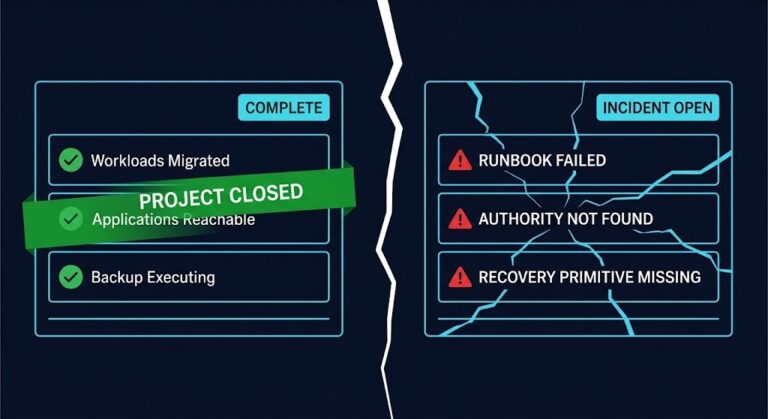
Infrastructure pipeline survivability begins when organizations recognize that the pipeline that declares, builds, and reconciles infrastructure is itself infrastructure. Most disaster recovery plans assume the opposite — that the tooling used to rebuild everything else will simply be there when it’s needed, untouched by whatever took the rest of the environment down.
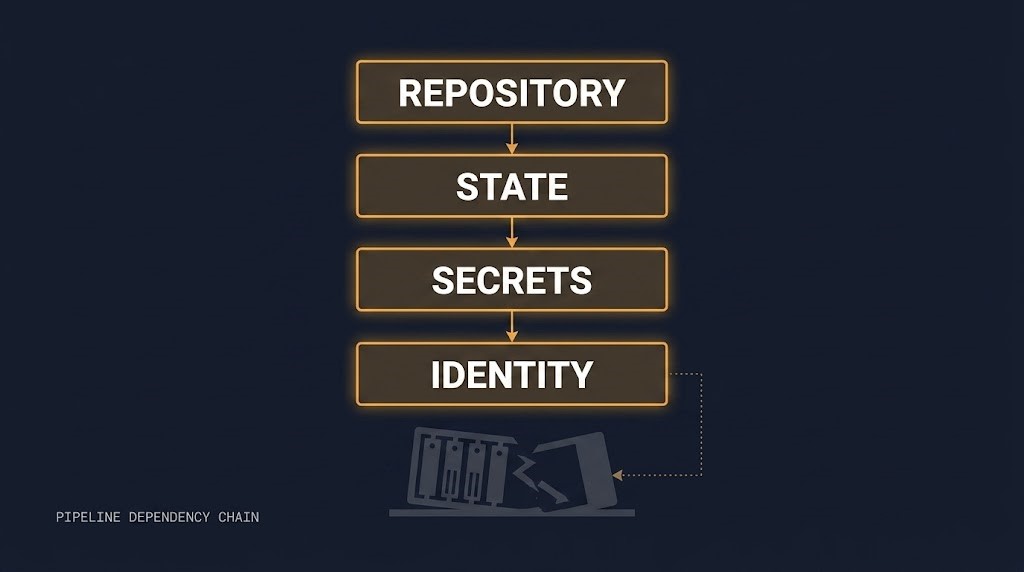
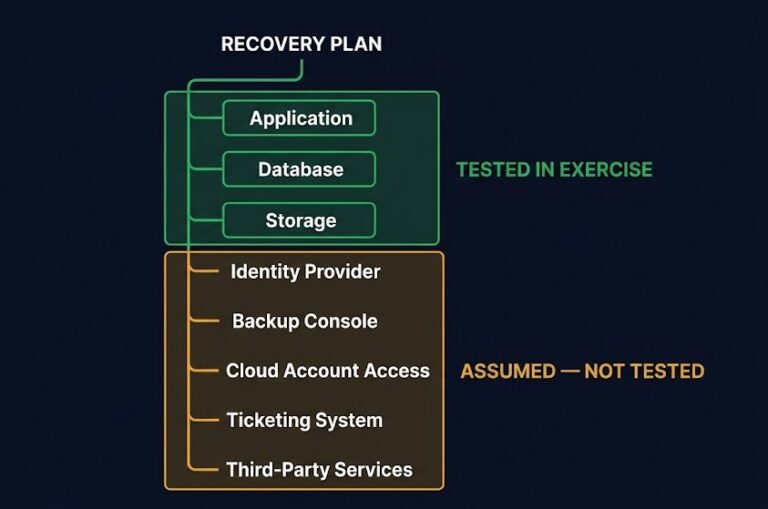
That assumption rarely gets tested, because it rarely gets named. Backup plans get tested. Failover plans get tested, at least on paper. The pipeline itself — the repository, the state file, the secrets store, the identity that lets automation execute — sits outside the exercise, treated as a tool rather than a dependency.
Infrastructure Pipeline Survivability Starts Before Recovery
Backup is not recovery. Recovery is not continuity. Infrastructure automation is not survivable infrastructure. Each of those inversions has already reshaped how this pillar thinks about resilience — and the same inversion applies one layer up. The system responsible for declaring, applying, and reconciling infrastructure state is not exempt from the failure conditions it’s meant to help recover from.
This is what infrastructure pipeline survivability actually asks: not whether workloads can be restored, but whether the system responsible for restoring them can restore itself first. If the control plane goes down alongside everything else, the organization isn’t just recovering workloads — it’s recovering the mechanism it planned to recover them with.
What Actually Has To Survive
It helps to stop describing a pipeline’s dependencies as components and start describing them as reconstruction authorities — because that’s the question each one actually answers. Where does desired state live? Who can apply it? Who can prove it was authorized? Who can recreate it if the original environment is gone? These four reconstruction authorities are the practical substance of infrastructure pipeline survivability — abstract until one of them is unreachable.
Four authorities answer those questions, and each one can fail independently of the others. The repository holds declared intent — but a repository without an accessible clone is a historical record, not a recovery asset. State holds the system’s understanding of what already exists — and state that can’t be reconstructed forces every subsequent apply to guess at the difference between what’s declared and what’s real, the same gap Infrastructure Evidence Gap describes at the moment of execution rather than the moment of recovery. Secrets hold the credentials that let anything execute at all — and a secrets store that dies with its host takes every downstream authority with it, whether or not the repository and state survived intact. Identity holds the authorization to act — a CI/CD service account, an OIDC federation, a deploy key — and identity that isn’t independently recoverable means none of the other three authorities matter, because nothing can act on them.
This isn’t a novel category of infrastructure risk — it’s the same reconstruction-authority framing that NIST’s SP 800-34 contingency planning guidance applies to critical system dependencies generally, just rarely applied to the pipeline itself. None of these fail loudly during normal operation. They fail exactly once, at the moment they’re needed, which is what makes this a survivability boundary rather than an operational nuisance.
Why This Isn’t The Same Gap State Gravity Already Named
It’s worth being precise here, because the two frameworks sit close enough in this pillar’s lineage to blur together if the distinction isn’t stated plainly. State Gravity describes the increasing cost and complexity of changing infrastructure state as accumulated state exerts pull on every subsequent architectural decision. Infrastructure pipeline survivability and State Gravity address adjacent but distinct failure mechanisms: State Gravity is about the cost of reconstruction, not whether reconstruction is possible at all.
The two compound rather than duplicate each other. State Gravity increases how difficult recovery becomes — more accumulated state means a harder reconstruction job even under ideal conditions. Pipeline Dependency Collapse prevents that reconstruction from starting in the first place, regardless of how much or how little state gravity has accumulated. An organization can have low state gravity and still fail this boundary completely if its secrets store was hosted in the same blast radius as everything else.
Failover Plausibility Assumes This Boundary Already Holds
This distinction matters enough to state directly, because without it, this framework reads as a rename of one that already exists. Multi-cloud failover design — the Failover Plausibility Gap — asks whether a documented recovery path could plausibly execute under real failure conditions. That’s a question about the failover mechanism: given that the infrastructure definition exists, the deployment path exists, identity can execute, state can be reconciled, and secrets can be retrieved, will the designed recovery path actually run?
The boundary underneath that one asks whether that pipeline remains reconstructable when the original operating environment — the one the failover plan was designed inside — is unavailable. A failover design assumes an operational pipeline exists to execute it. Failover plausibility fails when the recovery path was designed but doesn’t execute. Pipeline survivability fails when the recovery path can’t even begin, because the system required to declare and apply it was never made recoverable independent of what it was supposed to recover.
That ordering matters. Evidence has to exist before state can be recovered. State has to be recoverable before the pipeline can be reconstructed. The pipeline has to be reconstructable before infrastructure can be recreated. Only once all of that holds does the question of whether failover can plausibly execute even become relevant.
The Boundary: Pipeline Dependency Collapse
The boundary is Framework #164 — infrastructure pipeline survivability made explicit as a named architectural concept.
FRAMEWORK #164 — INFRASTRUCTURE PIPELINE SURVIVABILITY BOUNDARY
The point at which infrastructure recovery depends on a pipeline whose own dependencies were never made survivable.
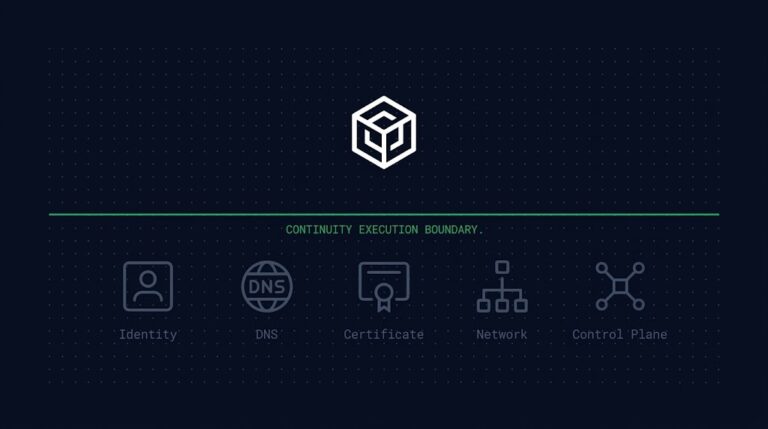
Pipeline Dependency Collapse concentrates wherever repo access, state storage, secrets, or automation identity share a blast radius with the infrastructure they’re meant to rebuild — the failure surfaces only once, at incident time, and it’s the moment recovery is least equipped to absorb it.
Architectural Relationships
Why It Connects
Governs the upstream question — a pipeline can’t prove its own reconstruction was authorized without the evidence chain Infrastructure Evidence Gap establishes.
Explore Framework →Why It Connects
Compounds the recovery cost — State Gravity increases how difficult reconstruction is; Pipeline Dependency Collapse prevents that reconstruction from starting at all.
Explore Framework →Why It Connects
Sits downstream — Failover Plausibility Gap asks whether the recovery path executes; Pipeline Dependency Collapse asks whether the mechanism that would execute it still exists.
Explore Framework →Why It Connects
Both sit in the governance lineage of this pillar, but Policy Intent Drift addresses declared-versus-enforced divergence, not reconstruction capability.
Explore Framework →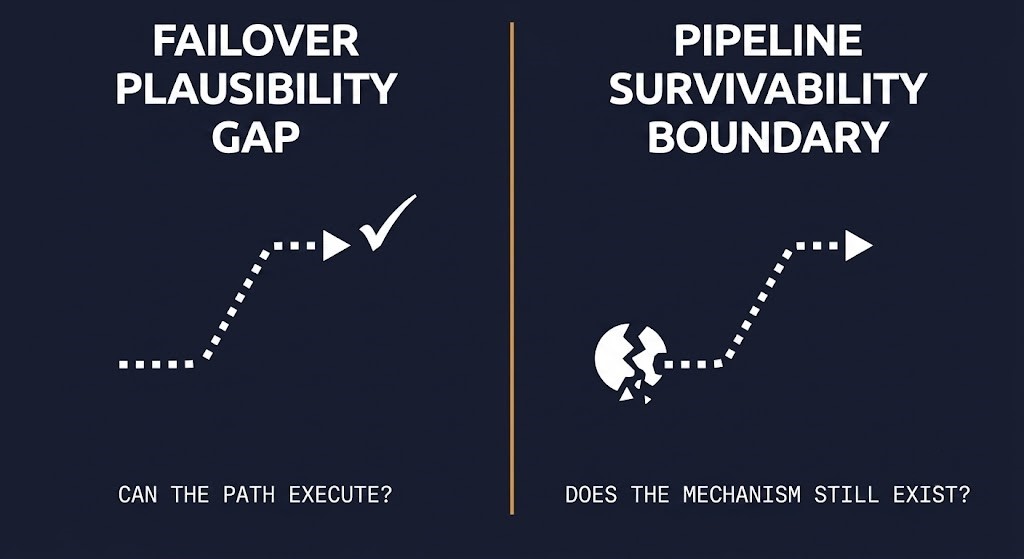
The distinction from Failover Plausibility Gap is worth holding onto in concrete terms: a documented multi-cloud failover path can be perfectly designed and still fail this boundary, if the pipeline that would execute it depends on a secrets store hosted in the same region that just went dark.
Two organizations discussed elsewhere in this pillar’s coverage make the pattern visible in practice. One kept its Terraform state in an S3 bucket with versioning enabled but no cross-region replication — survivable against accidental deletion, not survivable against a regional outage that took down the account itself. Another rotated its CI/CD deploy keys through a secrets manager that lived inside the same Kubernetes cluster the pipeline was meant to rebuild — a circular dependency invisible until the cluster was the thing that needed rebuilding. Neither organization had a failover design failure. Both had a pipeline survivability failure, discovered at the only moment it’s expensive to discover it.
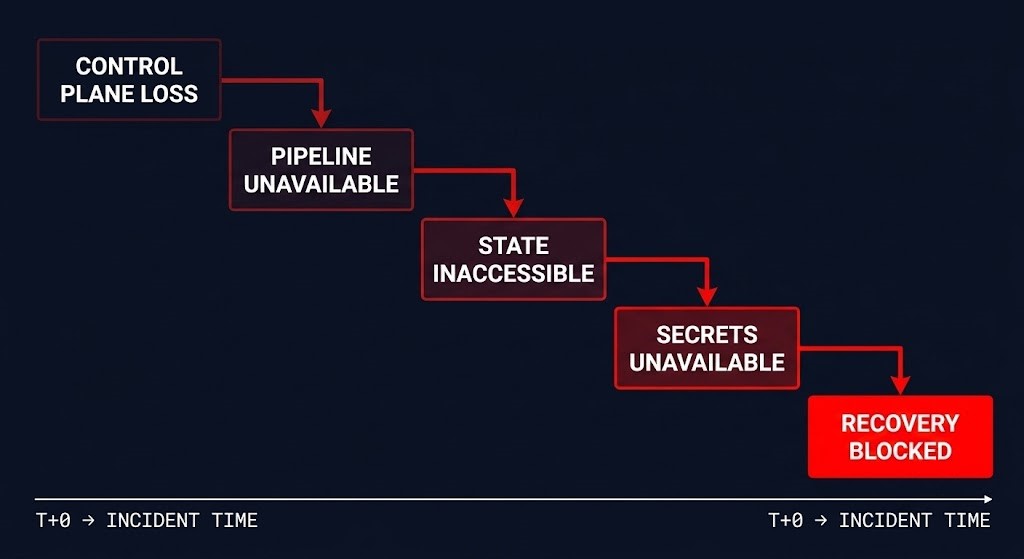
Closing this gap doesn’t require new tooling so much as a genuine audit of where each of the four reconstruction authorities actually lives, and whether that location shares a failure domain with anything it’s supposed to help recover. Repository access needs a path that doesn’t depend on the primary environment being reachable. State needs a location outside the blast radius it’s meant to describe, a discipline covered in more detail in HashiCorp’s Terraform state and backend documentation. Secrets need retrieval that doesn’t loop back through the system being rebuilt. Identity needs a recovery path independent of the infrastructure it authorizes changes to. None of these are exotic requirements — they’re just rarely tested, because the pipeline is rarely treated as a dependency worth testing.
Architect’s Verdict
Infrastructure survivability begins before infrastructure recovery. The pipeline that declares, builds, and reconciles infrastructure is itself infrastructure — and most organizations have never designed it to survive its own loss. Infrastructure pipeline survivability is not a compliance checkbox — it’s the difference between a recovery that begins and one that stalls at the first missing dependency. That gap doesn’t show up in a tabletop exercise built around workload failover. It shows up exactly once, at incident time, when recovery is supposed to begin and instead starts with rebuilding the mechanism recovery was supposed to run on.
Additional Resources
Editorial Integrity & Security Protocol
This technical deep-dive adheres to the Rack2Cloud Deterministic Integrity Standard. All benchmarks and security audits are derived from zero-trust validation protocols within our isolated lab environments. No vendor influence.

R.M.
Senior Solutions Architect with 25+ years of experience in HCI, cloud strategy, and data resilience. As the lead behind Rack2Cloud, I focus on lab-verified guidance for complex enterprise transitions. View Credentials →
Get the Playbooks Vendors Won’t Publish
Field-tested blueprints for migration, HCI, sovereign infrastructure, and AI architecture. Real failure-mode analysis. No marketing filler. Delivered weekly.
Select your infrastructure paths. Receive field-tested blueprints direct to your inbox.
- > Virtualization & Migration Physics
- > Cloud Strategy & Egress Math
- > Data Protection & RTO Reality
- > AI Infrastructure & GPU Fabric
Zero spam. Includes The Dispatch weekly drop.
Need Architectural Guidance?
Unbiased infrastructure audit for your migration, cloud strategy, or HCI transition.
>_ Request Triage Session